Cryptocurrency Posts
Crypto Briefing
AI-driven financial advice could significantly impact Circle's revenue, highlighting the growing influence of AI on financial markets.
The post Circle faces 20% revenue risk from AI agents, Mizuho warns appeared first on Crypto Briefing.
Meta's strategic equity raise underscores its aggressive investment in AI infrastructure, potentially reshaping its market position and shareholder dynamics.
The post Meta prices depositary shares linked to Series A preferred stock in massive equity raise appeared first on Crypto Briefing.
Bitcoin's reduced volatility may shift its perception from a speculative asset to a viable portfolio component, challenging traditional stock views.
The post Grayscale says Bitcoin is now less volatile than Oracle, Coinbase, Honeywell and SanDisk appeared first on Crypto Briefing.
Bitcoin's ETF inflows highlight its market dominance, while Ether's outflows suggest shifting investor confidence and potential volatility.
The post Bitcoin ETFs pull in $110 million as Ether funds shed $88.58 million appeared first on Crypto Briefing.
Nvidia's GPU longevity could reshape AI asset valuation, enhancing financial stability and altering market dynamics for AI companies.
The post Nvidia extends GPU lifespan to 8 years, impacting AI financing strategies appeared first on Crypto Briefing.
Bitcoin Magazine
Bitcoin Magazine
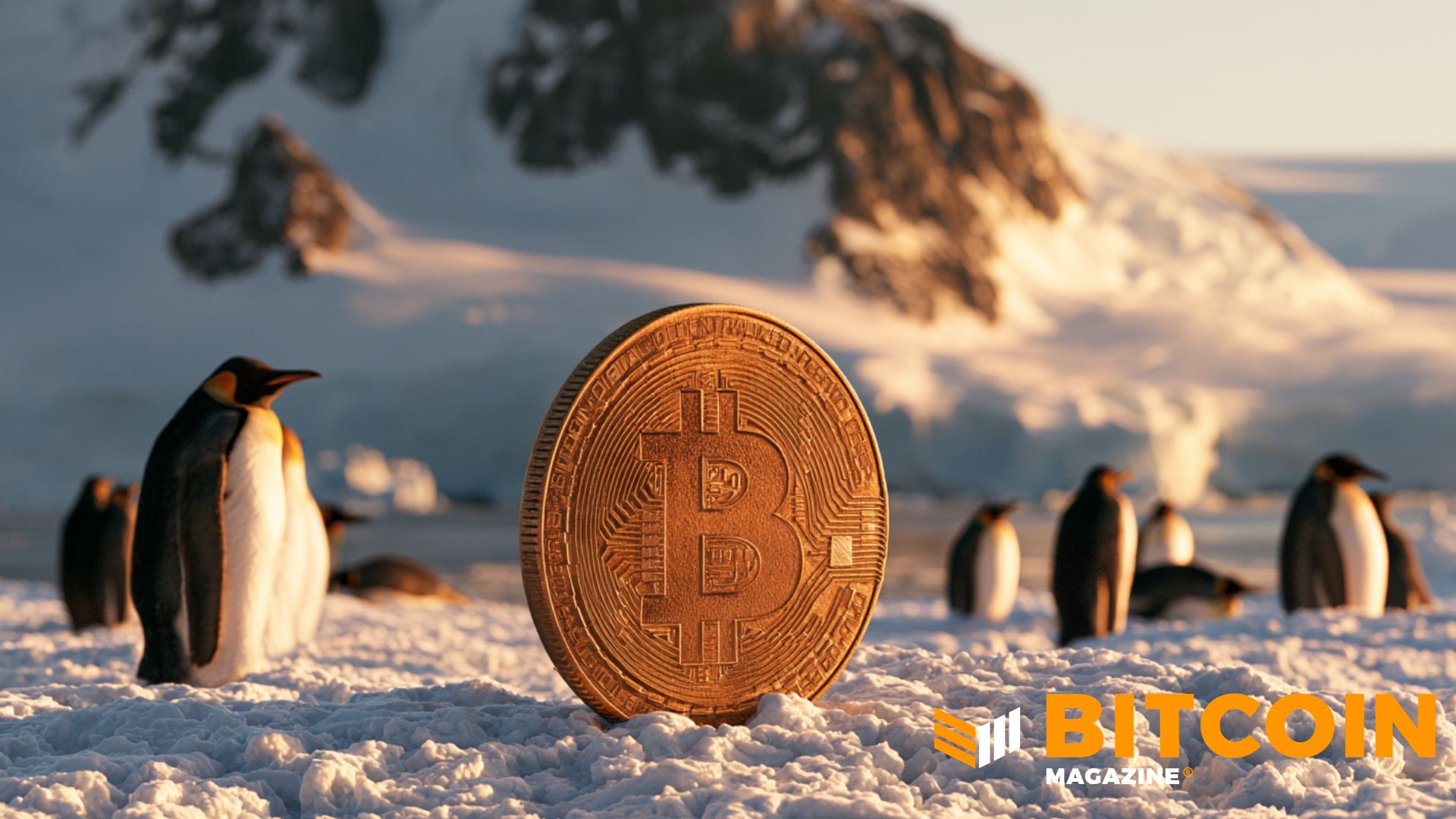
Cold Storage Goes South: bitcoin++ Announces Antarctica Edition
Bitcoin developers have gathered all around the world in places like Austin, Berlin, and Florianópolis, to name a few. In early 2028, a group of them plans to meet at the bottom of the world. bitcoin++ has announced Antarctica: Cold Storage Edition, scheduled for January 24 to February 5, 2028. There are only 22 spots available.
The event pairs a technical conference with an expedition ship that departs from Ushuaia, Argentina, crosses the Drake Passage, explores the Antarctic Peninsula, and returns to Ushuaia.
The event plays on bitcoin’s cold storage, the practice of keeping keys offline. The organizers describe the trip as a way to take the conversation somewhere colder, with room for discussions that would otherwise fit into a hallway.
bitcoin++ runs technical conferences, workshops, and hackathons for bitcoin developers. The series began in Austin in 2022 and has since held events in Berlin, Florianópolis, Buenos Aires, Mexico City, Riga, Istanbul, Taipei, Las Vegas, Vienna, Nairobi, Toronto, and Seoul. Each edition carries a theme, from “learn me a bitcoin” in Austin in 2022 to “lightning” in Berlin in 2025.
The organization counts some 20 archived editions. Its next conference, bitcoin++ Seoul, privacy edition, takes place November 5 and 6, 2026.
Penguins, parkas, and private keys
The trip runs 13 days and 12 nights. The ship leaves Ushuaia on January 24 and crosses the Drake Passage to the western coast of the Antarctic Peninsula. Possible stops include Neko Harbour, Paradise Bay, Port Lockroy, and the Lemaire Channel.
According to the trip’s website, activities may include kayaking, camping, hiking, snowshoeing, and Zodiac outings. The organizers note that weather, ice, and expedition decisions determine where the ship lands.
The conference follows an unconference format. Attendees propose the talks, demos, and discussions. The ship will have Starlink and a private room for impromptu hackathons and working sessions.
Cost and booking
Reservations are open right now. Fares are quoted in US dollars per person and range from $14,900 in a four-person cabin to $16,700 in a two-person cabin. Passengers may pay in five equal installments or pay in full at signup. Paying the full fare in bitcoin reduces the cost by 5%. The cost of the fare includes parkas.
The final payment is due October 1, 2027. Medical, evacuation, and repatriation insurance is required and purchased separately. Sponsors can place their brands on the expedition parkas. Placements range from $5,000 to $25,000, and each covers about 22 parkas.
The expedition explores the Antarctic Peninsula, not the geographic South Pole.
This post Cold Storage Goes South: bitcoin++ Announces Antarctica Edition first appeared on Bitcoin Magazine and is written by Micah Zimmerman.
Bitcoin Magazine

Blink Wallet Adds Inactivity Fee to Custodial Accounts, Accelerating Migration to Self Custody
Blink Wallet announced a new $1 a month inactivity fee, aimed at custodial accounts that have not logged in to the app in over 12 months.
The decision was put into motion in early September via a Terms of Service change, with push notifications sent out to inactive users, and the first charge made by mid-October. Fees charged will be refunded if users log back in within 12 months, according to a blog post published by the company.
The fee, which only affects custodial accounts, serves to relieve the burden of inactive accounts on the startup. According to the announcement, these inactive accounts have ongoing costs such as “ledger and infrastructure, retention of verification records, compliance monitoring and reporting, and support claims.” These costs are in turn borne by active user accounts via normal in-app transaction fees.
A source familiar with the matter told Bitcoin Magazine that around a hundred thousand such accounts fit the inactive category at the time of the first fee charge, with an aggregate balance of over $800,000. The first fee pulled in about $45,000, mostly from accounts that had dust amounts of bitcoin inactive for over a year. None of these figures could be independently verified.
A Bit of History
Blink Wallet may be one of the most popular Bitcoin wallets in the world, favored by advocates of Bitcoin Circular Economies across Latin America and Africa. Designed for an audience not already familiar with Bitcoin, the wallet first came to prominence as the ‘Bitcoin Beach Wallet’. It grew out of El Salvador’s initial wave of Bitcoin adoption, choosing design principles similar to Wallet of Satoshi, which had seen viral success in earlier years. The wallet was initially custodial and oriented around fast Lightning payments, with the innovative option of hedging value in USD via the Stable Sats feature.
Historically, custodial wallets have seen accelerated early growth compared to their non-custodial counterparts. It is arguably due to the friction introduced by non-custodial setup steps like the 12-word backup, but also by the lack of key material under the company’s control, which enabled features like the first generation of Stable Sats in the first place.
Because of the smooth interface and user experience Blink offered, it quickly became a favorite for evangelists to recommend. One particular evangelist allegedly got everyone he met to download the app and gave them about $1 worth of bitcoin. Some of those new users might have stuck around. But events like today’s Blink announcement put into question the effectiveness of such evangelism strategies, given that they may just be turned into dormant dust accounts.
Blink was eventually spun off from Galoy Inc its founding firm, to be run by Lukas Duczko and a new board of directors. The announcement published in October 2024 stated that Duczko now had a controlling stake in the company, while Galoy continued to be a service provider and minority stakeholder. The Bitcoin Beach Fund was also established at the time, seeded with Blink shares as part of the transaction. The wallet once headquartered in El Salvador is now based in the free economic zone of Roatán, Honduras, though it maintains corporate entities in El Salvador and the United States.
Headwinds
Despite its success gaining international adoption among Bitcoin circular economies, evangelists and supporters of the Lightning Network, the company has also faced significant headwinds. And not just Blink but custodial wallets in general, like Wallet of Satoshi, Alby, and Blue Wallet, all phased out their custodial wallet offerings in recent years, pivoting to self custody infrastructure like Spark. The tide began to rise with the EU’s MiCA regulations, which sought licensing and KYC compliance standards from custodians that these wallets simply could not provide.
On the U.S. side of the pond, the Samourai Wallet case and the broader war on crypto by the Biden administration pushed wallet operators outside of the country, with notable examples like Phoenix Wallet, Wallet of Satoshi, Wasabi Wallet, and Blink, limiting or altogether exiting American app stores. The legal uncertainty took place under the shadow of the Samourai Wallet and Tornado Cash cases, which the industry read as threats to user privacy and certainly to self custody wallets, let alone custodial ones.
Fast forward a couple of years and Google Play decided to enforce EU and American laws by limiting Play Store distribution of wallets or exchange apps that do not hold licenses in corresponding jurisdictions. The viral nature and stunningly easy-to-use apps that were possible thanks to custodial Lightning had, in a matter of 2 years, become a liability. It was time to pivot to self custody.
Nobody Said it was Easy
By 2025, Blink’s counterparts already offered self custody options; WOS was beginning to push their Spark-powered wallet, with 2027 as the deadline for custody wallet users to migrate. Alby had shipped a feature to connect self-hosted Lightning nodes to its hub and shut down its custodial Lightning option. Blue wallet had long ago shut down its custodial offer and had since doubled down on becoming an onchain wallet for new and power users alike.
Unlike its competitors, however, Blink’s biggest differentiator is the Stable Sats feature, which likely required a significant redesign to fit the limitations of self custody. It wasn’t until June 2026 that Blink launched its Spark supported self custodial wallet, a big move and one that its user base is still adapting to.
To make things worse, on September 19th, hackers managed to withdraw 6.61 bitcoins from custodial wallet users via compromised admin tools. The company’s backers quickly announced they would make the affected users whole, and the bleeding was stopped, but the blow nevertheless must have shaken the company.
Remarkably, despite some of the most difficult years for the Bitcoin wallet industry, Blink wallet has so far not just survived but stayed in the game. It has retained the slick design that made it so popular, while delivering advanced features that users in developing nations need, such as dollar-denominated value at the speed of lightning, meanwhile pivoting to self custody. The inactivity fee is but an inevitable step further down that transition. Perhaps having teams like Blink’s working on self custody will yield a new crop of sovereign technologies, its fruits badly needed by a sector of the industry battered by regulators and now AI cyber threats.
This post Blink Wallet Adds Inactivity Fee to Custodial Accounts, Accelerating Migration to Self Custody first appeared on Bitcoin Magazine and is written by Juan Galt.
 ▶
▶Bitcoin Magazine

Coinbase Institutional Co-CEO: Bitcoin’s “Second Wave” of Institutional Capital has Arrived
Seven of the largest banks in the world are now running on Coinbase infrastructure, and Brett Tejpaul, Co-CEO of Coinbase Institutional, says they’re having a “Kodak moment.” He joins Grace Remington and Sean Hagan to explain why the driver has shifted from Bitcoin ETFs to stablecoin payments now that money can move from a Citi account to USDC, across the blockchain in a second, and into a corporate account on the other side. He also gives a candid read on Bitcoin: the macro setup is great, the performance has been disappointing, and institutions aren’t yet treating it as anything but a tech trade.
Chapters:
0:00 Seven of the World’s Largest Banks Are Using Coinbase Infrastructure
1:19 From ETFs to Payments: Citi, USDC and Instant Bank-to-Blockchain Transfers
2:44 $400 Million an Hour in Stablecoins and the Banks’ “Kodak Moment”
4:38 Stablecoins Are a “Speck of Dust”: Payment Providers First, Then Banks
6:10 Agentic Commerce Arriving at the Same Time as the Big Players
6:49 Is Bitcoin Still a Leveraged Tech Trade? “Disappointing” Performance, Great Setup
8:44 Connecting U.S. Funds to Deribit’s 85% Options Market Share
11:06 The Second Wave: Net-New Entrants and Coinbase’s “Amazon to AWS” Pivot
12:57 Activating the Whole U.S. Through Coinbase Infrastructure
13:56 Quantum, 90% ETF Custody Share and “Safe Forever”
DISCLAIMER: The views and opinions expressed in this show are those of the participants and do not necessarily reflect the official policy or position of BTC Inc., Bitcoin Magazine, or any affiliated entities. This content is provided for informational and educational purposes only and should not be construed as investment, legal, tax, or accounting advice. Nothing contained in this show constitutes a solicitation, recommendation, endorsement, or offer to buy or sell any securities or financial instruments. Viewers should consult their own advisors before making financial or business decisions.
This post Coinbase Institutional Co-CEO: Bitcoin’s “Second Wave” of Institutional Capital has Arrived first appeared on Bitcoin Magazine and is written by Patrick Green.
Bitcoin Magazine
Bitcoin Price Hovers Near $80,000 as Traders Await Fed Decision
Bitcoin price traded near $80,000 on Monday, after falling about 2% earlier in the session. The price has dipped below that level several times in recent days and recovered each time.
Selling pressure has been building. Spot Bitcoin ETFs recorded about $635 million in outflows on October 22. A brief drop below $80,000 last week also triggered roughly $800 million in liquidations of long positions, or bets that prices would rise.
The next major test to look out for is the Federal Reserve’s two-day meeting, which ends October 28. The Fed raised its target range to 3.75% to 4% in September, and its minutes suggested another increase could come by year-end.
Most recent market odds favor the Fed holding rates steady, though those odds have shifted. Traders are watching Fed Chair Kevin Warsh’s remarks for signs of a December hike.
Higher interest rates typically pull money away from risky assets, including crypto. Broadly speaking, a hold could keep bitcoin price between roughly $80,000 and $88,000. A rate hike could push it toward the lower end of that range.
Bitcoin price backdrop
Geopolitical tensions are also weighing on markets. Oil rose above $100 a barrel in early September as strikes between the U.S. and Iran escalated. Higher energy prices feed into inflation, which affects the Fed’s decisions.
In tech, Anthropic is reportedly preparing an initial public offering that could value the AI company near $965 billion. The timing has shifted toward the weeks before the November midterm elections, but no date has been confirmed.
U.S. stocks surged a bit Monday as investors geared up for a busy week of Big Tech earnings and the Federal Reserve’s interest-rate decision. The Nasdaq rose 0.8%, the S&P 500 gained 0.6%, and the Dow climbed 0.3%.
Alphabet and Microsoft report Wednesday, followed by Amazon Thursday, while markets largely expect the Fed to hold rates steady.
AI-related stocks rallied following Anthropic’s IPO filing. Tesla jumped 6%, while Meta plans to raise up to $95 billion for AI investments.
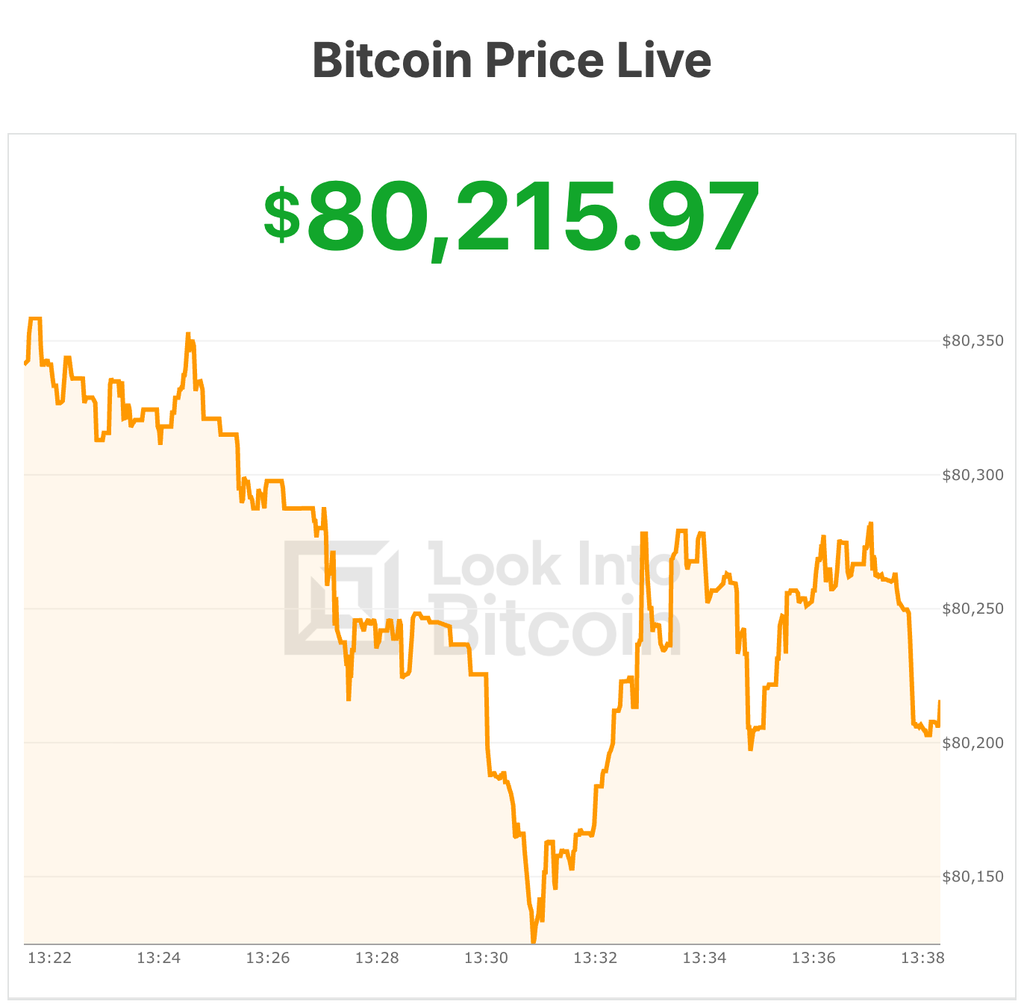
As of writing, bitcoin price trades at $80,215, down nearly $4,000 or 4.75%, on the month. Over the past month, prices have ranged from a high of $86,806.95 to a low of $79,397.76. Bitcoin price peaked above $86,000 in early October, then slid toward $80,000 in the second week of the month.
A brief rally around October 21 pushed it back near $84,000, but those gains faded within days. Trading volume over the past 24 hours reached about $18.12 billion.
Bitcoin price remains far below its all-time high of $126,277.05.
This post Bitcoin Price Hovers Near $80,000 as Traders Await Fed Decision first appeared on Bitcoin Magazine and is written by Micah Zimmerman.
Bitcoin Magazine
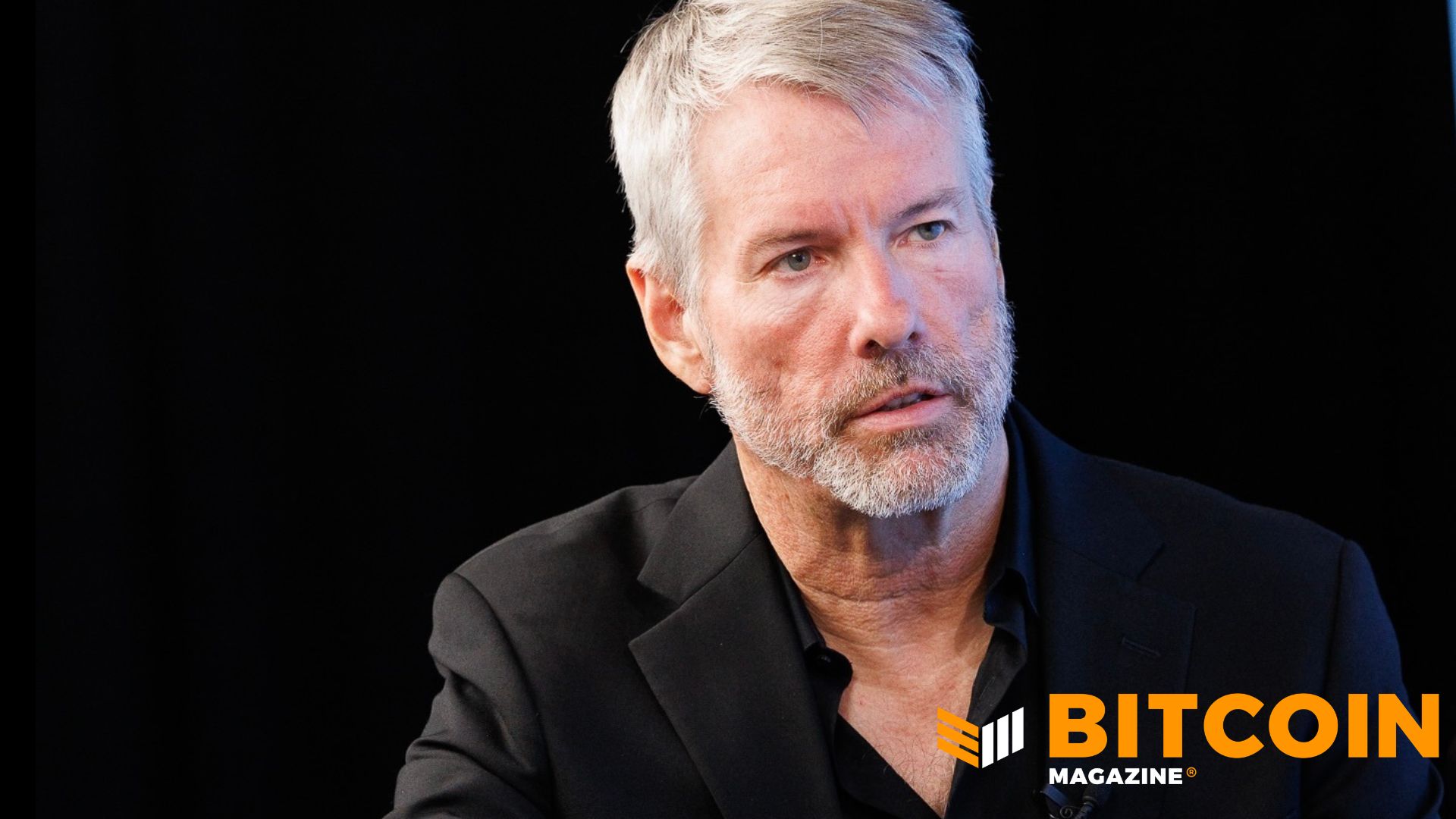
Strategy (MSTR) Pauses Bitcoin Buying and Spends $205 Million on Preferred Stock
Strategy reported no bitcoin purchases or sales during the week of October 19 through 25. The company continues to hold 848,517 BTC, acquired for $64.02 billion at an average price of $75,446 per bitcoin.
Its cash went toward repurchasing $204.9 million of STRC preferred stock, and the firm kept a $4.83 billion cash reserve, according to a company release.
Michael Saylor’s company built its treasury into the largest corporate bitcoin holdings in the world through stock sales and convertible debt, using the proceeds to buy coins. That pattern has changed somewhat this year. The company has paused purchases several times and directed money toward buybacks of its preferred shares.
The company has had stints of pauses, from a week when the company halted its bitcoin buys to a stretch in which it sold bitcoin after five weeks without buying.
In September, the company repurchased $176 million of STRC in one week and expanded its digital credit securities repurchase program from $1 billion to $2 billion.
Strategy’s preferred dividend
STRC is a preferred stock with a variable dividend, designed to trade near its $100 face value. When the shares fall below that level, as they have during recent market swings, buying them back shrinks the preferred claim. Retiring $100 of stated value for $86.52 cuts the claim by a larger amount than the cash spent, which lifts net bitcoin per share.
Bitcoin traded near $80,000 on Monday, October 26, after slipping below that level in early Asian hours. A weekend selloff pushed the price to the low $79,000’s, a level not seen in over a month.
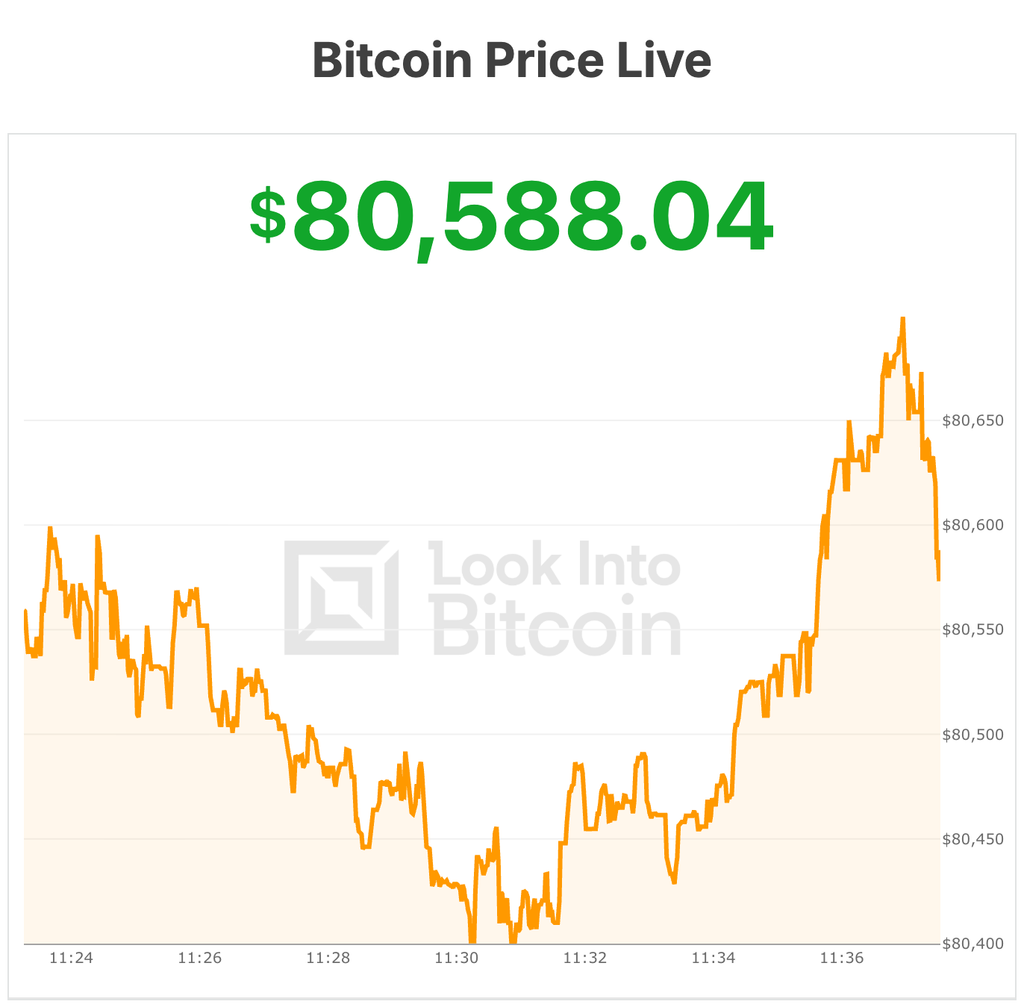
Strategy’s average cost of $75,446 sits below that price, so the company’s holdings show a paper gain of around $3.9 billion. The $4.83 billion reserve covers preferred dividends and debt interest, according to company reporting.
Strategy’s buyback capacity depends on preferred stock trading below par and on cash from common stock sales, a funding mix that has shifted toward stock sales this year.
The company has offered no timetable for resuming bitcoin buys.
This post Strategy (MSTR) Pauses Bitcoin Buying and Spends $205 Million on Preferred Stock first appeared on Bitcoin Magazine and is written by Micah Zimmerman.
CryptoSlate
Bitquery measured outside buying within roughly 1.3 seconds at 53% versus 52% in samples that predate the final 200ms reduction.
Read the full story on CryptoSlate
Understand the crypto stories that matter and what to watch next. Get The Catalyst in your inbox
The Foundation’s proposed rewrite would end cohort elections and seat nominees unless a veto reaches 20% of active votable OP supply.
Read the full story on CryptoSlate
Understand the crypto stories that matter and what to watch next. Get The Catalyst in your inbox
Babylon’s proposed direct route can bypass pool funding, while fees, borrower surplus and WBTC-denominated debt retain separate payment requirements.
Read the full story on CryptoSlate
Understand the crypto stories that matter and what to watch next. Get The Catalyst in your inbox
Anthropic filed for a Nasdaq IPO Monday, reporting a quarterly operating profit as crypto markets valued it near $2 trillion. The Claude developer submitted its S-1 registration statement to the US Securities and Exchange Commission (SEC) on Oct. 26, seeking a listing under the ticker ANT. Goldman Sachs and Morgan Stanley are leading the offering,…
Read the full story on CryptoSlate
Understand the crypto stories that matter and what to watch next. Get The Catalyst in your inbox
An already-compromised signer could recover the key through many malicious ECDSA messages when the application ignored a critical stop condition.
Read the full story on CryptoSlate
Understand the crypto stories that matter and what to watch next. Get The Catalyst in your inbox
CryptoTicker.io
Here is what is documented: bitcoin trades at $79,568 on Tuesday morning, measured at 05:41 Central European Time on CoinGecko, and on Friday at 9 a.m. a total of 135,545 bitcoin contracts expire on the options exchange Deribit. Our reading follows further down: the expiry explains why the price has been moving in a narrow range for days, but it says nothing about the direction afterwards.
If you hold bitcoin, this is no academic question. An expiry of this size ties up capital until Friday morning that is then released, and this time it coincides with the last trading day of the month. Anyone looking to sell or add this week meets a market whose range is being held artificially tight.
The night stayed tight, $79,421 marked the low
Over the past 24 hours, bitcoin traded between $79,421 and $80,680. That is a gap of $1,259, or 1.6 percent measured against the low. For comparison: in the week before, the distance between daily high and daily low regularly exceeded $3,000. The market has not calmed down because there is nothing to trade, then, but because the hand that usually reaches in is currently tied.
Little has shifted against yesterday morning's level. Bitcoin stood at $79,978 then and at $79,568 today. That is $410 less, or 0.5 percent. The $80,000 mark, which the price briefly reclaimed over the course of Monday, again failed to hold into the evening.
The wider arc is clearer. The daily closes of the past six days read $84,082, $81,328, $81,102, $80,811, $80,049 and $80,029. Six consecutive days lower, 5.4 percent in total. From the monthly high of $86,490 on October 5, the price is now 8.0 percent away. That is a setback, but not yet a correction in the sense of the usual ten percent threshold.
135,545 bitcoin options expire on Friday at 9 a.m.
The date is fixed. Deribit, the largest exchange for crypto options, settles its monthly contracts on the last Friday of the month, this time on October 30 at 08:00 UTC. In Central European Time, that is 9 a.m. since the switch to winter time. According to the figures from the Deribit interface on Tuesday morning, 135,545 contracts are open. Each contract stands for one bitcoin, so roughly $10.8 billion at the current price.
No other date on the calendar carries more right now. The next weekly expiry on November 6 carries 13,285 contracts, the November monthly expiry 39,492. Only the annual expiry on December 25 returns to the same order of magnitude, with 135,192 contracts.
The split is lopsided. Calls account for 87,393 contracts, puts for 48,152. The put-to-call ratio stands at 0.55, so the majority of positions are betting on rising prices. That majority simply no longer matches the price.

Why the $95,000 strikes end up empty-handed
Of the 87,393 open calls, 76,112 carry a strike above the current price. That is 87.1 percent. By far the thickest block sits at $95,000 with 19,951 contracts, followed by $100,000 with 11,284 and $90,000 with 10,710. For those positions to be worth anything on Friday, bitcoin would have to rise 19 percent within three days.
The other side looks like a mirror image. Of the 48,152 puts, 39,436 sit below the current price, or 81.9 percent. The largest block sits at $70,000 with 4,352 contracts, the second largest at $75,000 with 2,993. Only 8,715 puts are in the money today.
On balance, the vast majority of both sides expires worthless. That is no accident but the normal case on an expiry day, and it is the reason why the premiums paid for weeks for price targets beyond $90,000 land in full with the sellers of those options on Friday.
How an options expiry works on the bitcoin price
The mechanism is less mysterious than it sounds. Whoever sells a call carries the risk of rising prices and hedges against it by actually holding part of the underlying amount. If the price rises towards the strike, they have to buy more; if it falls, they sell again. This running hedge generates buying and selling that has nothing to do with an opinion about bitcoin.
The closer the expiry comes, and the further the large blocks sit out of the money, the smaller that hedge becomes. At $95,000 and a price of $79,568 it is effectively zero. What remains is a narrow band around the current price in which the hedge still reacts, and that is exactly where the market has been moving for days. After Friday morning, that clamp falls away.
The second figure often quoted on such days is the computed centre of gravity, known in the market as max pain. It describes the price at which all open options together produce the smallest payout, the price, in other words, at which the buyers of those options lose the most in aggregate. For Friday's expiry, that point sits at $78,000, around 2 percent below the current price.
What matters is what this number is not. The centre of gravity is not a price target that anyone is steering towards. It follows from a calculation over the positions open today and shifts with every newly opened contract. Read as a price target, it mistakes a snapshot for an intention.
The monthly close falls on the same day
There is also a second date. October 31 is a Saturday, which makes Friday, October 30 the last trading day of the month on regulated markets. Fund houses that value and rebalance their holdings at month-end trade on that day. The options expiry at 9 a.m. and the monthly close in the evening therefore sit within one trading day.
Before that comes the US Federal Reserve meeting on Wednesday and Thursday. Three dates in three days, two of them falling on the same Friday: that explains the market's reticence better than any trend line.

How to check your holding period yourself
For investors in Germany, more than the price hangs on the moment of sale. Gains from selling crypto assets count as private disposals. What decides the outcome is how long the sold holding was held, and the relevant date is the acquisition date of each individual unit, not the moment the account was opened.
Three points count now. First, pull the list of your purchases with dates and amounts from your exchange or your wallet software. Second, assign to every planned sale the units that actually leave, because the order determines which acquisition date applies. Third, work out whether a sale this week is really necessary or whether a later date is more favourable for tax. We keep the current state of the rules and of the ongoing reform debate up to date on our page on the crypto holding period.
Anyone buying and selling on Friday to capture the move of the expiry day should also know that every repurchase restarts the clock for that holding. A daily gain of 2 percent can therefore work out more expensive than sitting still.
If you go into the expiry through leveraged products, the point to check is a different one: here it is not the acquisition date that decides but your liquidation price. Which platforms carry which fees and which margin obligations is set out in our comparison of perp DEX venues.
Our assessment: the expiry explains the range, not the direction
From the newsroom's point of view, the narrow trading range of recent days is well explained, and without any drama. Three pieces of evidence support that: the daily range of 1.6 percent against more than $3,000 in the previous week, 135,545 open contracts expiring on Friday, and a computed centre of gravity at $78,000, close to the current price.
Against it stands the fact that no direction can be derived from any of this. The positioning shows where money was placed in recent weeks, namely on $95,000 and $100,000, and those are precisely the bets that come away empty on Friday. A failed bet says nothing about what the next one will be. Add to that the central bank meeting on Wednesday, whose outcome can shift the picture entirely by Friday.
What we conclude: the calm of this week is a consequence of the calendar, not a statement about the value of bitcoin. Anyone planning a decision anyway has a market with small ranges, and correspondingly modest execution costs, until Friday morning. Anyone waiting for a breakout waits until after the expiry. This is expressly not a recommendation to buy or sell.
Friday's options expiry: $78,000 is the costliest price for holders
In summary: bitcoin stands at $79,568 on Tuesday morning, after six falling daily closes and 8.0 percent below the monthly high. On Friday at 9 a.m., 135,545 contracts expire, with 87.1 percent of the calls sitting hopelessly far above the market. The computed centre of gravity at $78,000 marks the price at which the buyers of those options come out worst in aggregate, and it sits just below today's level. The actual move begins after that.
(As of October 27, 2026. All prices in this article refer to Tuesday morning, and the open-contract figures to the same hour. This article is not investment advice. Prices and fee structures change; check the terms with the provider before you buy. Crypto assets fluctuate strongly, and a total loss of the capital employed is possible.)
Internet Computer trades at 2.63 dollars, which leaves it 71 percent below the twelve-month high of 8.97 dollars set in November 2025. At the same time the price stands 30 percent above the twelve-month low of 2.02 dollars, marked in early August 2026. Between those two marks sits the question readers keep putting to us: is ICP a good buy at current prices, or is this a falling knife?
cryptoticker.io compiled the price data and every average in this article on 27 October 2026, from the daily closing prices of the past 365 days published by CoinMarketCap. Readers who want the longer horizon will find it in our Internet Computer price prediction.
Internet Computer price analysis: where the ICP price stands today
The ICP price is 2.63 dollars. The 200-day moving average runs at 2.75 dollars, the 50-day moving average at 2.90 dollars. Both lines sit above the price, and both are falling. For a buyer hoping to catch a floor, that is the least comfortable arrangement available: the market trades below its own mean, and the mean is coming down to meet it.
Three marks matter for the coming weeks. On the downside, support lies at 2.02 dollars, the twelve-month low of 2 August 2026. That zone held, and from there the price has gained 24.1 percent over 90 days. The current zone between 2.60 and 2.70 dollars is where the market has settled after the retreat of the past four weeks. On the upside, the 200-day mark at 2.75 dollars is the first genuine hurdle, followed by the 50-day average at 2.90 dollars.
Market capitalisation stands at 1.47 billion dollars, which is rank 53 in the overall market. A year ago ICP traded at 3.29 dollars, so the twelve-month balance is a loss of 20.1 percent. That reads as moderate, and it hides the range: between the high and the low of the past twelve months lies a factor of more than four.
The Internet Computer downtrend: broken or merely interrupted
The third quarter argues for a broken downtrend. From the low at 2.02 dollars the price climbed for 90 days, 24.1 percent in total, and the August low has not been tested since. A market that declines to revisit its low has at the very least lost sellers.
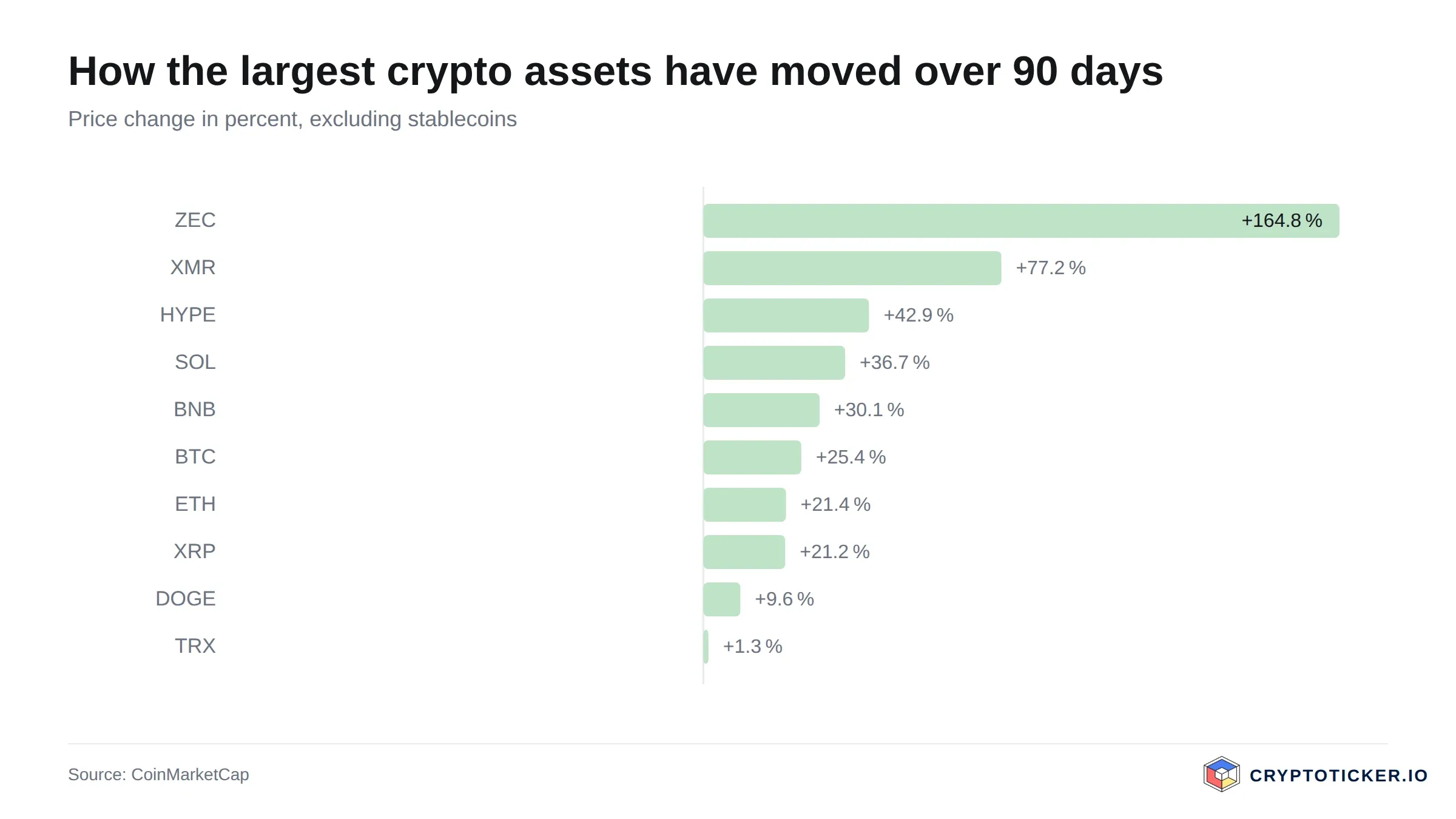
Almost everything else argues against a reversal. Over 30 days the balance is a loss of 17.6 percent, over seven days a loss of 7.4 percent. The price crossed the 200-day average at 2.75 dollars from above during October, and the 50-day average at 2.90 dollars still runs above the 200-day line, though it is falling faster. Should it cross from above, chart readers get the signal they call a death cross. The arrangement is not there yet, and it is moving in that direction.
Our reading is explicitly an assumption rather than a finding: the downtrend is interrupted, not broken. Since August the price has built a higher floor, but it has not produced a higher high, and that is precisely the condition for a change of trend. As long as ICP stays below 2.90 dollars, the picture remains a downtrend with a pause in it.
What RSI and moving averages mean for an ICP entry
The daily RSI reads 36.2. It is the most instructive figure in the whole dataset, because it sits in the lower third while remaining above the level of 30 at which a market counts as oversold. For an entry that says two things. First, selling pressure is real without being panicked: there is no capitulation of the kind that historically delivers the best entry prices. Second, there is still room below before technical buyers take any interest at all.
The moving averages supply the counterpart. A price 4.3 percent under the 200-day line and 9.4 percent under the 50-day line does not qualify as an exceptional situation; in severe sell-offs, gaps of 30 or 40 percent are routine. Anyone buying here is buying a weak patch rather than a washout.
In practice that argues for staggering an entry instead of placing a single one: a first tranche at 2.63 dollars, a second around 2.20 dollars, a third only once the August low of 2.02 dollars has held again. Anyone waiting for confirmation takes the day ICP reclaims 2.90 dollars as the signal and pays roughly 10 percent more for it.
What trading volume reveals about demand for Internet Computer
In 24 hours, ICP worth roughly 51 million dollars changes hands. Measured against a market capitalisation of 1.47 billion dollars that is 3.5 percent, and the real information sits in that ratio: high enough to move larger quantities without a noticeable price concession, too low for a wave of fresh demand.
What matters is how the figure relates to the direction of the price. A loss of 17.6 percent over 30 days on ordinary volume describes a market in which buyers are absent, not one in which sellers are pressing. For someone considering an entry, that is the better of the two conditions: absent buyers come back once there is a reason.
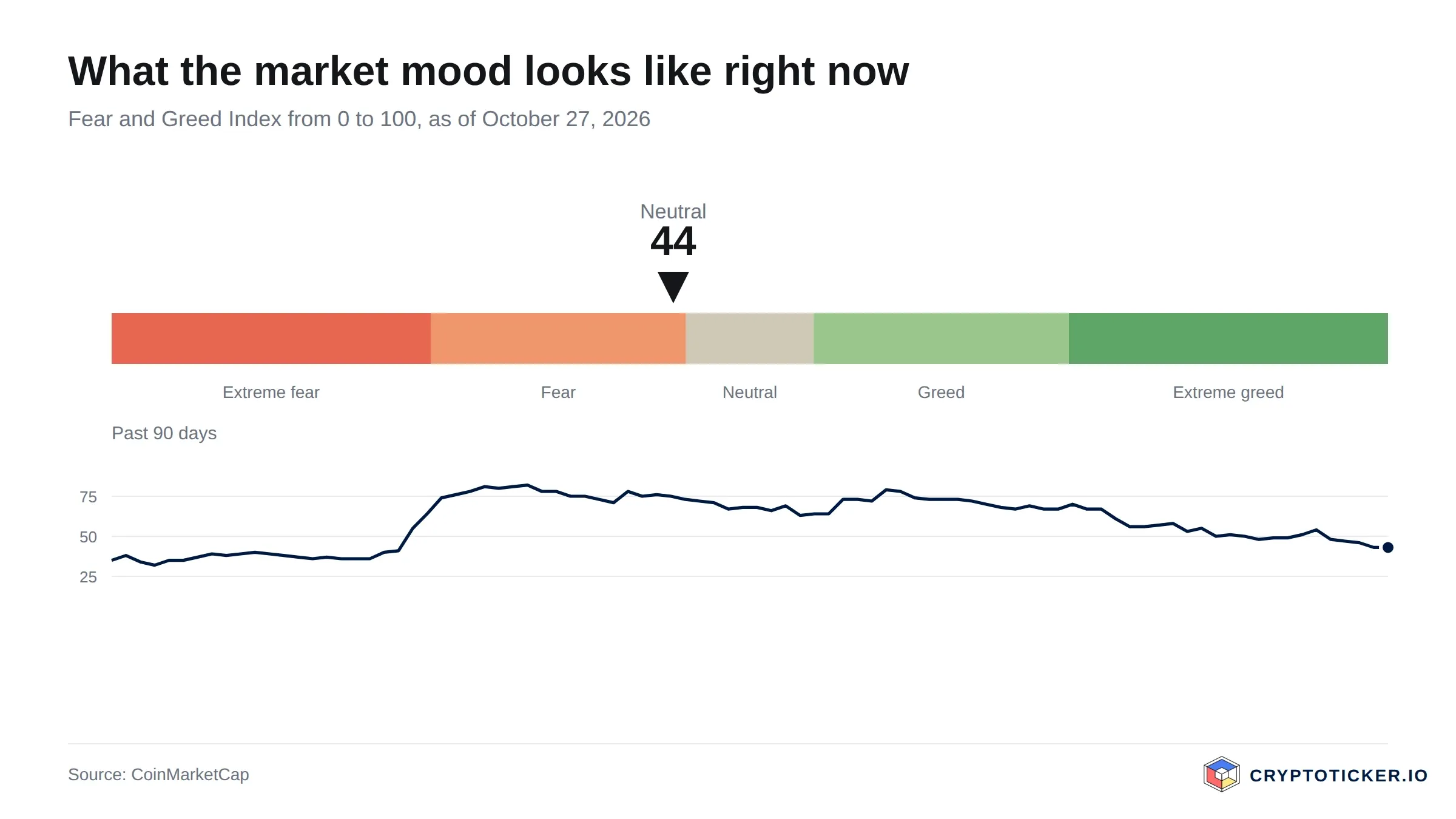
The wider frame comes from the market as a whole. The Fear and Greed Index reads 44 and therefore sits in neutral territory: no setting in which fear is pushing prices down, and none in which euphoria is carrying them up. ICP is falling considerably harder than the average in that market, and that points to reasons inside the project.
Structural factors that speak for Internet Computer
Supply is the most unusual point about ICP, and it is misread in both directions. There are 558.2 million tokens in circulation, and that is also the entire supply. There is no fixed ceiling: new tokens are created as rewards for node operators and for votes in the network, while others disappear for good when developers convert them into computing power. That burning pays for the infrastructure; it is not a marketing device. How the two sides currently stand against each other is published continuously in the network's circulation statistics.
From that follows the actual investment case. ICP is one of the few assets whose supply shrinks when the blockchain is genuinely used. On most projects the user pays the fee; here the developer pays in advance. The network built by the DFINITY Foundation runs applications entirely inside its own nodes, interface and data storage included, which makes it the counter-design to a blockchain that only stores entries in a ledger.
The third factor is the yield paid through network governance. Lock ICP for a fixed term and you receive voting rights and running rewards, and the longer the lock, the larger both become. Locked tokens are withdrawn from the market, and the lock is real: before the term expires you cannot reach your tokens.
Three points in favour of buying Internet Computer at current prices
First, the valuation against its own history. At 2.63 dollars ICP trades 71 percent below the twelve-month high of 8.97 dollars. Anyone assuming a return to the zone around 5 dollars is not talking about a new record, but about half the distance the price has given up since November 2025.
Second, the floor that held. The low of 2.02 dollars held in August, and the price stands 30 percent above it. That gives a clearly nameable mark at which the assumption fails. It is more than most assets in this size class have to offer.
Third, supply against rising usage. If the number of applications on the blockchain grows, demand for computing power rises with it, and tokens are destroyed for good to pay for it. An asset whose supply shrinks as usage climbs has a lever that a pure payment network does not. That lever only works, however, if usage actually increases.
Three points against buying Internet Computer at current prices
First, the position on the chart. The price sits below both important averages, at 2.75 and 2.90 dollars, and both are falling. An RSI of 36.2 shows weakness without reaching the extreme from which recoveries tend to start. Anyone buying here is buying against the trend and needs patience measured in months.
Second, supply without a ceiling. The missing ceiling is an advantage only for as long as more tokens burn into computing power than are newly created. If usage stays weak, the rewards for node operators and voters outweigh the burn, and supply grows. For an asset already under pressure, that is additional headwind.
Third, the gap to the wider market. ICP has lost 17.6 percent over 30 days in an overall market whose Fear and Greed Index reads 44. When an asset falls harder than its surroundings without any market panic, the cause lies closer to the project. From rank 53 the way back leads only through new user numbers.
Buying and storing Internet Computer: costs, exchanges and wallets
ICP is listed on every large European trading venue. For investors in Europe the first question is whether the provider operates under European supervision, because segregation of client assets, the complaints route and tax records all depend on it. Our overview sits in the comparison of the best regulated crypto exchanges; how one of the largest platforms works in practice is set out in our Kraken reviews.
Two items drive the cost. The trading fee at most providers runs between 0.1 and 1.5 percent per purchase, depending on whether you go through a trading interface or an instant-buy window. On top of that comes the spread between the buying and the selling price, more noticeable at 3.5 percent daily turnover against market capitalisation than it is with Bitcoin. On small amounts it often costs more than the fee itself.
Storage comes in two forms. Investors who only want to hold move the tokens to a wallet of their own; which devices qualify is shown in our hardware wallet comparison. Investors who want the network reward lock the tokens for a chosen term. That lock is the price of the reward.
Is Internet Computer a good buy at current prices: short term and long term
In the short term, over weeks to three months, the data argue against a purchase. The price sits below both averages, momentum points down with a loss of 7.4 percent over seven days, and an RSI of 36.2 leaves room before any excess. The likely path is a sideways range between 2.20 and 2.75 dollars. That assumption is refuted as soon as ICP reclaims the 50-day average at 2.90 dollars and holds there for more than a week.
In the long term, over two to three years, everything hangs on one measurable quantity: does the blockchain burn more tokens through genuine usage than it hands out in rewards? If the answer turns positive and stays there, today's price is what an asset with shrinking supply and a market capitalisation of 1.47 billion dollars costs. If usage fails to arrive, the technology will not help, and the 71 percent gap to the twelve-month high of 8.97 dollars describes a valuation correction rather than an opportunity. This assumption counts as refuted if supply grows across several quarters while the price falls below 2.02 dollars.
On balance ICP at current prices is neither a bargain nor a trap, but a bet on usage with a named threshold. Both scenarios can be checked against figures the network publishes itself.
Buying Internet Computer: The key points for your decision
- Set the threshold before you buy. 2.90 dollars on the upside and 2.02 dollars on the downside decide whether your assumption holds. The longer horizons are set out in our Internet Computer price prediction.
- Choose the venue on supervision and cost. With a spread of this width, fees bite harder than they do on large coins. One European regulated provider is examined in our Bitpanda reviews.
- Decide storage and locking separately. Settle first whether you want to hold or to take the network reward, then set the split. For the held portion, our wallet comparison sets out the options.
Disclosure: Some of the providers mentioned in this article work with us through partner programmes. This has no influence on the price analysis or on our assessment of the chart; the price data come from a public market data source and can be verified there.
(As of 27 October 2026. This article is not investment advice. Prices, fees and terms change; check them with the provider before every purchase. Crypto assets are subject to severe price swings, and a total loss is possible.)
Anyone who has spent years collecting Pi in the app and now holds the tokens on mainnet runs into a practical problem when selling: PI trading happens almost entirely without euros. On October 27, 2026 cryptoticker.io checked all 24 trading pairs listed for PI across 16 venues and sorted them by quote currency. Two of them quote a euro price. Those two account for 0.55 percent of daily turnover.
This coincides with the project's first developer gathering of its own. On October 22 the Pi Core Team announced the Pi Ecosystem Summit, a three-day online format running from November 17 to 19 at which a hackathon is also to be presented. The price meanwhile sits 8.6 percent above its all-time low.
PI trades at $0.0767 and sits 8.6 percent above its all-time low
PI costs $0.0767, or 0.0686 euros, according to CoinGecko at around 1am on Tuesday morning. Over the past 24 hours the price added 1.86 percent; over seven days it is down 2.29 percent, and over 30 days down 16.41 percent. The weekly high came on October 22 at $0.0794, the weekly low on October 26 at $0.0752. The 24-hour range ran from $0.0744 to $0.0769.
What matters for context is the distance to the downside. The all-time low of $0.070586 dates from July 14, 2026. From the current price that leaves 8.6 percent of room. Upwards the gap is far wider: the all-time high of $2.99 from February 26, 2025 sits 97.4 percent above today's level. How the levels have shifted since is shown by the PI price prediction with its running price data.
Market capitalisation stands at $866 million, around 775 million euros. That puts PI 82nd among crypto assets by market value. The fully diluted valuation, meaning the market value once the entire allocation is released, is $1.33 billion, which is $466 million higher.
Only two of 24 trading pairs quote a euro price
For the analysis, cryptoticker.io recorded every listed trading pair for PI individually, with venue, quote currency, daily turnover and bid-ask spread. The basis is the set of pairs listed at CoinGecko as of October 27, 2026. Twenty-four pairs across 16 venues were checked. cryptoticker.io compiled this analysis itself on October 27, 2026.
The result by quote currency is unambiguous. Pairs against the dollar stablecoin USDT take 95.07 percent of converted daily turnover, spread across 14 venues. Euro pairs take 0.55 percent. In between sit USDC at 1.64 percent, the stablecoin USD1 at 1.22 percent, the Turkish lira at 0.76 percent, the US dollar as book currency at 0.59 percent and the Brazilian real at 0.17 percent.
Exactly two venues quote a euro price: OKX at 0.0687 euros and Kraken at 0.06852 euros. The bid-ask spread, the gap between the best buy and the best sell order, came to 0.12 percent at Kraken and 0.28 percent at OKX. Both are narrow for a crypto asset of this size. The problem is not the spread but the depth behind it: together the two euro pairs made around $24,700 in daily turnover.
Why a USDT pair means a second conversion for pioneers in Europe
With a USDT pair, your PI goes out against a stablecoin pegged to the US dollar rather than against euros. Only a second trade turns that into euros. Fees fall due twice in the process, and between the two steps you carry the dollar-euro exchange rate risk. On small amounts that detour can cost a noticeable share of the proceeds. Which platforms run a direct euro pair, and at what fees, is set out in the overview of the best crypto exchanges.

CoinUp.io and OKX together carry 60 percent of daily turnover
By venue the market is narrow too. The two largest, CoinUp.io at 30.2 percent and OKX at 30.0 percent, together carry 60.2 percent of turnover. Gate follows at 7.5 percent, CoinW and Bitget at 6.5 percent each, LBank at 6.2 percent and MEXC at 3.9 percent. Kraken, the only other venue with a euro pair, comes to 0.7 percent.
Two figures for total turnover do not line up. CoinGecko reports daily turnover for PI of $3.16 million. The sum of the 24 individual pairs comes to $4.50 million. The difference arises because not every listed venue feeds into the headline number. For the split by quote currency that changes nothing, since both sides come from the same pair list; for the absolute size of the market, the range of $3.16 million to $4.50 million applies.
The first Pi Ecosystem Summit runs from November 17 to 19
The Pi Core Team announced its first Ecosystem Summit on October 22. The gathering runs from November 17 to 19 as a purely online format and is aimed, according to the team, expressly at developers rather than at the wider user base. That sets it apart from Pi Day and Pi2Day, the project's existing fixtures.
According to the Core Team's announcement, the programme covers platform releases, demonstrations of individual developer tools, presentations of applications from around the project, conversations with the Core Team about the platform's future direction, and the unveiling of a hackathon. On the hackathon itself the announcement names neither dates nor entry conditions nor prize money; details are to follow during the summit. The agenda and the broadcast channel are also still outstanding.
In the same announcement the Core Team gives figures on the state of the project: more than 60 million active pioneers, more than 300 applications on mainnet, more than 420,000 nodes and more than 18.1 million users who have completed identity verification. These figures come from the project itself and cannot be verified from outside.
Protocol 28 went live on mainnet on October 16
The technical step before that lies eleven days back. Pi runs on an adapted version of the Stellar software, and Protocol 28 takes over the Stellar release of the same name. According to the Core Team the upgrade improves how the network handles delays in transaction data and lets developers update groups of smart contracts together and amend stored data. Node operators had to switch by October 13. Which parts ran to which deadline is set out in the article on Protocol 28 and its deadlines.
The completion remains open. The Core Team declared the mainnet switch finished on October 22, while the project's public node page still listed the switch as ongoing a week later. How many of the nodes cited are actually running Protocol 28 is not published by the project. For balances, circulating supply and mining in the app the switch has no consequences, on the team's account.
6.08 billion PI sit outside circulation
The second reason for the thin trading depth lies on the supply side. In circulation are 11.29 billion PI. The total allocated to date comes to 17.37 billion PI. The difference of 6.08 billion tokens, or 35.0 percent of the allocated holding, is not yet freely tradable. Measured against the maximum supply of 100 billion PI, 11.3 percent is in circulation today.
The Core Team publishes no official monthly schedule for further releases. Estimates from various analytics services for the current year diverge widely, and none can be checked against a source from the project. All that is verifiable is the gap between circulation and the allocated holding, and it does not close by itself: every release meets a market whose euro side currently turns over a five-figure dollar sum per day.

Buying route, custody and leverage: the legal frame for PI in Germany
Since July 1, 2026 trading venues may only offer their services in the EU with authorisation under the Markets in Crypto-Assets Regulation, MiCA for short. For a PI purchase that means one thing first: check whether the provider is allowed to take on German customers at all before you transfer money. Without that authorisation a provider may neither take on nor continue to serve German customers.
On custody, PI is a special case. Mining happens in the app, and the tokens land first in the project's wallet, access to which is tied to completed identity verification and migration to mainnet. Only after that can they be moved to a trading venue. A balance held at an exchange is legally a claim against the provider and not property in your own hands. Statutory deposit protection does not apply to crypto assets.
Leveraged products on PI are precarious at this market depth. A market whose euro side turns over around $24,700 a day can be moved with comparatively small orders. A leveraged position can then be liquidated, meaning force-closed, before the price returns to your entry. If you work with leverage regardless, set the stop before the order rather than after it.
The one-year holding period applies to PI as to any other crypto asset
For tax purposes the German tax office treats PI like any other crypto asset. Under current law, a gain from a private disposal transaction stays tax-free if more than a year lies between acquisition and sale. Below that period, an exemption threshold of 1,000 euros per calendar year applies to all private disposal transactions together. Once it is exceeded, the entire gain becomes taxable, not only the portion above the line.
With mined tokens, the date of acquisition is where this turns practical: what counts is when the individual token accrued to you, not when you opened the account. Collecting small amounts daily over years calls for clean records. Tools that assign such inflows to the right period automatically take that work off your hands. A second point applies to PI: the detour via a USDT pair is a separate event for tax, because a swap from one crypto asset to another counts as a disposal.
The levels: $0.0706 to the downside, $0.0794 to the upside
Downwards the line is clearly marked. The all-time low of $0.0706 from July 14 is the lowest point the price has ever reached; below it there is no price history from which a floor could be read. Closer sits the weekly low of $0.0752 from October 26, which the price has since left behind.
Upwards two levels are visible. The weekly high of $0.0794 from October 22 is the nearer one; above it begins the round $0.08 mark, where the price lingered several times in October. These are observations from the price history to date and not price targets. The next date with possible bearing on the project is the summit from November 17.
PI in euros: OKX and Kraken are the only two routes
What the analysis means for you comes down to three steps:
- Settle your selling route before you want to sell. Of 24 trading pairs, two quote a euro price. If you want euros, check first whether your provider runs a euro pair for PI or whether the route goes via USDT. The platforms' fee models are set out in the overview of the best crypto exchanges.
- Check the provider's authorisation. Since July 2026 every platform serving EU customers needs MiCA authorisation. Which providers hold one is listed among the regulated crypto exchanges.
- Document the inflows from mining. For the one-year period, what counts is the day the individual token accrued to you. A tax tool assigns such amounts automatically, before the tax return comes due.
(As of October 27, 2026. This article is not investment advice. Prices and fee structures change; check the terms with the provider before you buy.)
Buying Bitcoin under 18 does not work on your own in Germany. No statute stops a 16-year-old from owning Bitcoin, yet the providers who handle the purchase will not take minors as customers, and a contract concluded without parental consent remains provisionally invalid. Two clean routes are left: the parents buy in their own name, or they buy and then gift the coins to the child. Which of the two is chosen decides who owns the coins, who pays the tax and who is liable if anyone later disputes the deal.
The question comes up more often than the legal position suggests. Teenagers hear about crypto assets at school, on video platforms and from friends, and many parents want to set something aside for their child that goes beyond a savings account. The obstacle sits in ordinary civil law. It has governed what minors can validly agree for more than a century, and it holds no special rule for crypto assets.
Can a 16-year-old buy Bitcoin in Germany?
The law separates ownership from the act of contracting. A minor may hold crypto assets. There is no age limit on owning Bitcoin, any more than there is on owning a bicycle. The catch sits in the acquisition. Anyone aged between seven and 17 has limited legal capacity, and under Section 107 of the German Civil Code (BGB) they need their legal guardian's consent for every declaration of intent that does not bring them a purely legal benefit. A purchase contract always carries an obligation too, namely payment, so it is never purely beneficial.
Where consent is missing, Section 108 BGB makes the contract dependent on the parents' subsequent approval. Lawyers call this interim state provisional invalidity. If the counterparty calls on the parents to declare themselves, they have two weeks to answer; silence counts as refusal. For a crypto purchase that means the deal hangs in the balance for as long as the parents withhold approval, whether the price has risen or fallen in the meantime.
Section 110 BGB: what the pocket-money rule covers in a crypto purchase
The best-known way out is Section 110 BGB, known in everyday German as the pocket-money paragraph. Its wording: a contract concluded without consent is valid from the outset if the minor performs their side using means given to them for that purpose or placed at their free disposal. Anyone who receives pocket money and buys a game in a shop with it concludes a valid contract the moment they pay. The official text of Section 110 BGB runs to three lines and demands exactly two things: the minor's own means, and performance in full.
Applied to a crypto purchase, that quickly becomes a problem. The provision assumes performance has already been rendered. A one-off payment out of pocket money satisfies it. An ongoing relationship does not.
Why the account counts differently from the single trade
Buying at an exchange or a broker takes more than a single payment. It takes an account first, which is a framework agreement with continuing duties on both sides: custody, identification, notifications, fees. A continuing obligation of that kind is precisely not performed in full at the moment it is signed, so Section 110 BGB does not cover it. The pocket-money rule saves the chocolate bar at the till; it does not save account opening at a financial services provider. This is where the independent route for minors ends, before the providers' own rules even come into play.
Why providers in Germany verify only from the age of 18
The second hurdle is contractual, and harder than the first because it leaves no grey area. The large trading venues exclude minors in their terms. The Bitpanda user agreement states under its customer restrictions that you may not register an account if you are not at least 18 years old or live in a country that prescribes a higher statutory minimum age. Other providers word it along the same lines.
The classification matters. This age limit comes from the providers' terms of business, not from any crypto regulation. Neither the European market regulation MiCA nor anti-money-laundering law names a minimum age of 18. What they require is unambiguous identification of the customer. Companies draw the line at the age of majority because otherwise they would have to check parental consent for every single transaction and carry the risk of approval being refused. To see which platforms are licensed in Germany and what they cost, the overview sits in the crypto exchange comparison. Either way, the account can only be opened by an adult account holder.
Routing the purchase through the verified account of a friend or an older sibling is no solution. It breaches the terms of every reputable provider, and it creates a practical problem that cannot be unwound later: balances and withdrawals run in the account holder's name. Who owns the coins in economic terms is of no interest to the platform, but it is very much of interest to the tax office.

The parent account: who legally owns the coins
The usual route looks like this. A parent opens an account in their own name, buys Bitcoin there and privately treats the holding as the child's money. In law it is not, at least not at first. The exchange's counterparty is the parent, and so is the owner and beneficial holder. In this arrangement the child has no claim as long as nothing has been transferred.
That gap between intention and legal position has consequences few people consider at the time of purchase. If the parent enters personal insolvency, the holding belongs to the insolvency estate. On death it falls into the estate and is divided among all heirs. In a divorce it counts towards the equalisation of accrued gains. Anyone who really wants the holding to sit with the child has to transfer it, and that transfer is a gift with rules of its own.
Parents represent their child jointly under Section 1629 BGB. Where both parents have custody, both act when a contract is concluded for the child. For a step that someone might later question, that is not a formality but the difference between valid and open to attack.
Junior accounts and crypto ETNs: the detour via a securities account
Alongside the direct purchase there is a second route, and it runs in the child's name. Banks and brokers maintain securities accounts for minors, often called junior accounts. The child is the holder, the parents manage it. Depending on the provider, exchange-traded notes on crypto assets can be held in one, known as ETNs. An ETN tracks the price without anyone holding coins in custody; in return the holder carries the risk that the issuer defaults.
Whether a particular institution permits crypto ETNs in a minor's account is set out in its terms and its product list, not in legislation. Many banks restrict which classes of security can be traded in a child's account. That question belongs before the account is opened rather than after, and the answer belongs in the file in writing. The difference from a direct purchase is larger than it looks: an ETN falls under the flat-rate withholding tax on investment income, while a directly held coin falls under the taxation of private disposal transactions with its one-year holding period. The same economic wish therefore leads to two entirely different tax regimes.
Gifting instead of buying on their behalf: a 400,000 euro allowance per parent
The cleanest way to get assets into the child's hands is a gift. Section 16 of the German Inheritance and Gift Tax Act (ErbStG) exempts acquisitions by children up to 400,000 euros, and that figure applies per parent. A mother and a father can therefore transfer 800,000 euros to one child with no gift tax falling due. Section 14 ErbStG does, however, aggregate several transfers from the same person within ten years. The allowance refills, but only once that period has run. The step-by-step process is set out in the article on gifting Bitcoin to children.
For the valuation, what counts is the moment of execution, when the coins actually reach the child. In a market that can swing by double digits in a single day, that is no detail: transferring during a weak phase uses up less of the allowance for the same number of coins.
The three-month notice to the tax office
Section 30 ErbStG obliges the recipient to notify the competent tax office in writing of every taxable acquisition within three months of becoming aware of it; with a gift, the duty also falls on the person whose assets the acquisition came from. The notice should state names, tax identification number, date, the object and value of the acquisition and the family relationship. An exception applies to gifts recorded by a notary. Where a transfer stays inside the allowance no tax arises at the end, but the duty to notify does not disappear with it.
Section 23 EStG: who pays the tax when the child sells
If the coins belong to the child, the child is the taxpayer. It has its own tax number, its own assessment and its own allowances. A gain on sale is attributed to the child, not to the parents. Crypto assets fall under Section 23 of the Income Tax Act (EStG): a sale within one year of acquisition is a private disposal transaction, and once the year has passed the gain is tax-free.
For gifted coins, the sentence that matters here sits in Section 23(1), third sentence, EStG: on a gratuitous acquisition, the predecessor's acquisition is attributed to the successor in title. If a parent bought the coins three years ago and transfers them to the child today, the one-year clock does not start again. The child can sell tax-free immediately. The reverse holds just as firmly: freshly bought coins bring the child a fresh one-year period. Which records of purchase date and purchase price are needed later is shown by the comparison of crypto tax software; reconstructing acquisition data years after the fact costs twice over.
The 1,000 euro threshold and the basic allowance: two limits on the child's side
Two figures decide whether any tax arises at all. The first sits in Section 23(3), fifth sentence, EStG: gains from private disposal transactions stay tax-free if the total gain in the calendar year comes to less than 1,000 euros. That is an exemption threshold, not an allowance. At 999 euros of gain everything stays tax-free; at 1,000 euros the full amount becomes taxable.
The second figure is the basic personal allowance. Section 32a EStG sets it at 12,348 euros from the 2026 assessment period. A child with no significant other income pays no income tax up to that line. In practice the combination of the two means that a child's account attracts no tax in most years. Only when a larger holding is sold inside the one-year period does the calculation start to move, and then the child's personal tax rate applies, which is as a rule lower than the parents'.
One practical note on sequence. Gifting first and letting the child sell afterwards shifts the gain to the child and into that low rate. If the parents sell first and gift the proceeds, the gain has already arisen with them. The sequence decides the tax burden, whatever the intention behind it.

Section 1642 BGB: what parents owe when investing a child's assets
Anyone managing money that belongs to a child works to a statutory standard. Section 1642 BGB requires parents to invest the child's money under their management according to the principles of sound asset management, so far as it is not to be kept available for expenditure. The old tie to trustee-grade investments has gone, but the current wording is no blank cheque. Sound asset management means diversification and a risk that fits the investment horizon. A child's entire savings in one highly volatile asset is hard to measure against that.
Section 1643 BGB comes on top. It makes certain transactions subject to approval by the family court by referring to the catalogue that applies to legal guardians. An ordinary securities or crypto purchase out of existing funds does not fall under that reservation; it becomes relevant for transactions of greater consequence, such as taking on credit for the child. Investing small amounts regularly is untouched by it. How such a standing order is set up and what it costs is set out in the comparison of Bitcoin savings plans.
The question becomes concrete on the 18th birthday at the latest. Parental responsibility for the assets ends there, and the child can dispose of the holding freely. Parents who have documented their management can show on that day what they bought, when, and why they invested it the way they did.
Student finance and welfare: when 15,000 euros of assets become a problem
One point is almost always overlooked when investing for children: assets held in the child's name count later towards income- and asset-tested benefits. Section 29 of the German Federal Training Assistance Act (BAföG) leaves 15,000 euros of assets out of account for students under 30. What matters are the circumstances at the time of application. Parents who build a holding above that threshold over the years may reduce their child's later entitlement, at exactly the moment the money is needed.
A similar mechanism applies to basic subsistence benefits, where the household's own assets are taken into account; the detail sits in the article on crypto holdings and German welfare benefits. None of this is an argument against saving for a child. It is an argument for choosing the amount and the timing of the transfer deliberately, instead of automatically putting everything in the child's name straight away.
Custody: who holds the private key for a child
If the coins stay on the platform, the provider there holds them, and the account holder is the adult parent. Move them to a self-custody wallet and the private key governs access. For a minor child that means the parents hold the key in trust until the child comes of age. A child who keeps their own recovery words can lose them, and a lost key is final.
That leads to a task with nothing to do with the price: access has to outlive the parents. Where the key is kept, who besides the parents knows about it and how the child can reach it in an emergency belongs in the same folder as the purchase records. How to put such access in order for an estate is described in the article on passing on crypto assets. Honesty also requires the reminder that a total loss is possible: crypto assets carry no deposit protection, the price can sit below the purchase price for years, and a holding meant for an education can be worth considerably less at the wrong moment.
Bitcoin under 18: without a parent account, every purchase stays open to attack
The independent purchase founders on Section 107 BGB and on the providers' terms, not on any crypto regulation. Two routes are workable, and both run through the parents. Three steps bring order to them:
- Open the account in a parent's name and record its purpose. Which platforms licensed in Germany come into question, and what trading and withdrawals cost, is shown by the exchange comparison. Note from the outset which purchase is intended for whom.
- Set the transfer to the child up as a gift. Record the date, the number of coins and the market value, file the notice under Section 30 ErbStG within three months, and secure the predecessor's acquisition data. Which tools keep that history cleanly is set out in the comparison of tax software.
- Spread the amount over a period rather than a single day. That smooths the entry price and keeps the child's holding below thresholds such as the 15,000 euros in Section 29 BAföG for as long as that makes sense. The terms for this are set out in the savings plan comparison.
(As of October 27, 2026. This article is not investment advice. Prices and fee structures change; check the terms with the provider before you buy.)
RAIN fell 11.4 percent on Monday to $0.00760. No single piece of news sits behind the move. What is weighing on the price is the structure of the supply: of 1,142.4 billion tokens in total, 431.6 billion are still locked, while trading turns over only $19.5 million a day. Against a market capitalisation of $5.40 billion, that means 0.36 percent changes hands per day.
For investors, that is the real information here. An eleven percent drop on a Monday evening is nothing unusual for a token of this size. A supply with more than a third still waiting to be released, and a market that on paper could not absorb that supply for months, does change the conditions under which you buy, hold or sell. Every figure in this article is from Monday evening and can be traced at CoinGecko and CoinMarketCap.
RAIN drops to $0.00760, 61 percent below its August high
The price moved between $0.007684 and $0.008649 on Monday. Over the week it is down 13.7 percent, over thirty days 40.7 percent. The high of August 25, 2026 was $0.019464; the price sits 61.0 percent below it.
The order of those numbers matters more than their size. A single day's loss can come from one large sell order. A decline of a good forty percent over a month that repeats across every time frame points to a persistent supply overhang. That is exactly what the breakdown of the supply shows.
For context, the wider market on the same evening: Bitcoin traded at $79,732, down 0.8 percent on the day before, and Ether at $2,305, down 1.7 percent. The fall in RAIN is therefore not a reflection of a broad market move but is markedly steeper than its surroundings.
431.6 billion tokens remain in vesting
Vesting means tokens are released on a fixed schedule and cannot be traded before then. RAIN has 710.8 billion tokens in circulation. Total supply is 1,142.4 billion tokens and the cap is 1,150 billion. That gives the figure at issue here: 431.6 billion tokens are still locked, or 37.8 percent of total supply.
At the current price, that locked amount is worth $3.28 billion. It will not come free in a single day, and nobody can credibly claim all of it will be sold. Part of it sits with teams and backers who are tied in for years. What counts is that the block exists and that the market knows about it.
The unlock of October 12 has already shown how the price responds. In our analysis after the unlock of October 16, 2026, market capitalisation still stood at $6.3 billion; it is now $5.40 billion. That event is over; the rest of the schedule is not.
Why the gap between circulating and total supply counts
A token's market capitalisation is calculated from the price and the circulating amount. Tokens in vesting are not included. If the circulating amount rises, the price has to fall for market capitalisation to stay the same. With RAIN this mechanism is not a theoretical case but measurable over the past thirty days: circulation grew and the price gave up 40.7 percent.

$5.40 billion market cap against $19.5 million a day: turnover runs at 0.36 percent
Turnover sets daily volume against market capitalisation and shows what share of an asset actually changes hands. For RAIN that is 0.36 percent a day. Among large crypto assets, that share regularly runs in the mid single digits.
This metric explains why the price gives way so clearly. When a sell order meets a thin order book, it moves the price further than the size of the order suggests. The technical term is slippage: the gap between the price you see when you submit an order and the price it is finally filled at. The thinner the trading, the wider that gap.
One calculation makes the ratio tangible. The locked tokens are worth $3.28 billion. At the current daily volume of $19.5 million, the market would need around 168 trading days to absorb an amount of that size. That is a ratio, not a forecast: nobody knows whether or when those tokens will be sold. The ratio does show the distance between the valuation and what trading can handle in a day. Where you trade therefore helps decide your fill price; regulated crypto exchanges compared differ considerably on spread and depth.
FDV and market cap are $3.28 billion apart
Fully diluted valuation, or FDV, applies the current price to the entire supply. For RAIN it stands at $8.68 billion against a market capitalisation of $5.40 billion. The gap of $3.28 billion is exactly the value of the locked tokens.
A gap like this is normal for young tokens; its size is not normal in every case. The gap describes how much valuation is still to enter circulation without any new capital having to flow into the market. For you it is a figure with a practical consequence: buying at today's market capitalisation means buying into a supply that is still growing.
A thin free float amplifies every wave of selling
Free float describes the part of the supply that can be traded freely. For RAIN that is the 62.2 percent in circulation. That share is not small. What counts, though, is not its share of supply but its relation to trading, and here the turnover of 0.36 percent shows a narrow base.
Two forces work together in a market like this. Sellers find only limited counterparty and push the price down. Buyers move the price up just as clearly, which is why such tokens rise so strikingly in an upswing. RAIN has shown both within a few weeks: in September the price jumped to $0.0134, and since the August high it has lost 61.0 percent.
In practice that means a market order is the most expensive tool in a thin order book. A limit order, where you set the price yourself, protects you from a fill at a price you did not want. The trade-off is that a limit order is not always filled.
The protocol on Arbitrum trades options and prediction markets
RAIN is the token of a decentralised options protocol on Arbitrum, a layer-2 blockchain on Ethereum. Users can create and trade their own markets there. Public markets are resolved through an oracle service, private ones by their creator. An oracle is the service that reports an outside-world result to a blockchain, such as the outcome of an event.
The protocol also provides for part of trading volume to be used to buy back and burn the token. Burning means permanently removing tokens from circulation. That mechanism works against dilution, and its scale hangs directly on trading volume. At $19.5 million in daily volume, it is small next to 431.6 billion locked tokens.
Anyone trading derivatives on tokens like this should know the difference between spot and perpetual. A perpetual is a futures contract with no expiry, in which a funding rate is settled regularly between buyers and sellers. With a thin spot market, the liquidation threshold sits closer to the entry price than the stated leverage would suggest. It is worth reading the provider's contract terms first.

The trading routes for RAIN have already narrowed
A token can fall without anything changing in its technology. What can change is access. In September we reported that Kraken liquidated RAIN positions and set a withdrawal deadline. For customers there, that was not a question of price but of timing.
That process is finished and says nothing about other providers. It does show what matters with tokens outside the front rank: the venue you bought on does not have to keep listing the token. Check directly with your provider whether RAIN remains tradable and withdrawable for you, rather than relying on a list from a few weeks ago.
MiCA, the holding period and leverage: the framework for German investors
Since the European regulation on markets in crypto-assets, MiCA, applies in full, service providers may only offer crypto-assets in the EU with a licence. For you that means checking the provider first, not the token: a licensed venue is supervised, an unlicensed one is not. Which tokens a provider lists is still its own decision.
On tax, a one-year holding period applies in Germany to private disposals. Sell within that period at a profit and the gain is in principle taxable; after a year has passed it is disregarded for a private disposal. With a token that has lost 40.7 percent over thirty days, the loss side matters just as much, because losses from such transactions can be offset within the same category of income. The details depend on your situation, and they belong in a tax return, not in a rule of thumb.
On custody, the same standard applies as for any other token on a layer-2 blockchain. Leave RAIN on the venue and you hold a claim against that provider. Hold the token yourself and you carry responsibility for the keys. Both routes are defensible; they simply distribute the risk differently.
The levels above and below: $0.00768 and $0.00865
On the downside, Monday's low of $0.00768 is the first point of reference. Should the price fall below it and stay there, the next reference cannot be derived from daily data. On the upside the daily high is $0.00865; above that begins the range the price moved in before Monday.
These levels are observation points, not price targets. For a decision they are only useful together with volume: a rise above $0.00865 on a continuing $19.5 million of daily volume means something different from the same rise on markedly higher volume. At a turnover of 0.36 percent, the price move alone says little.
What counts in the coming weeks is how the vesting schedule continues. We could not document a confirmed next release date for this article; the usual schedule services carried no retrievable information on it on Monday. As long as that remains the case, the block of 431.6 billion tokens is the figure to keep an eye on.
RAIN's remaining lockup: below $0.00768, turnover decides, not the news
- Check the venue and the fill. Look directly with your provider to see whether RAIN remains tradable and withdrawable, and compare spread and depth before you place an order. An overview of licensed providers for custody is in the hardware wallet comparison, and for trading itself at the venues.
- With derivatives, match leverage to market depth. At 0.36 percent turnover the liquidation threshold sits closer than the stated leverage suggests. Which platforms carry which contracts is shown in the perp DEX comparison.
- Document positions and deadlines. Record the purchase date, amount and price so the holding period and any loss offset can be proved later. Tax tools and portfolio trackers help with that.
(As of October 26, 2026. This article is not investment advice. Prices and fee structures change; check the terms with the provider before you buy.)
Decrypt
Ottawa opened a 60-day consultation on draft rules requiring one-to-one reserves and fast redemption from stablecoin issuers, while keeping the ban on paying holders interest.
OpenAI's mid-tier model now operates apps and screens more like a person would, with API prices 50% below GPT-5.6 Terra and an error rate that OpenAI says fell sharply.
Unitree's shares have jumped about 60% in under two weeks as investors bet OpenAI's GPT-6 Astra will give robots the brains they lack, turning the stock into an AI proxy.
The agreement, which follows similar deals with MLB and NHL, establishes information-sharing to guard against insider trading as sports betting migrates to CFTC-regulated venues.
Police in Seoul say a 32-year-old with no IT background used AI tools to break into about 90 hospitals, schools and companies, then pressed victims for roughly $270,000 combined.
U.Today - IT, AI and Fintech Daily News for You Today
Ripple has secured final US regulatory approval for its national trust bank, marking a major milestone for the company.
Despite the fact that multiple assets are holding above their respected key levels, the market has barely any fuel left for a proper recovery.
XRP Ledger co-creator David Schwartz has shared an enthusiastic message from Ripple's Swell Demo Day in New York, fueling anticipation ahead of the company's flagship conference.
Billionaire venture capitalist Tim Draper has praised Bitcoin creator Satoshi Nakamoto for his bold vision and optimism, crediting the mysterious figure with challenging the foundations of the global financial system.
American Airlines, Subway and Christian Louboutin already use Ripple’s new 24/7 treasury platform, which puts idle cash to work via RLUSD.
Blockonomi
TLDR:
- Ethereum core developers delayed the Glamsterdam fork on Hoodi after a ChainSecurity report.
- Gas already spent can return mid-transaction, which lets the gasleft() value rise during execution.
- A failed sub-call can return gas, so an unreachable path runs and the transaction looks successful.
- Developers will review contracts this week, and the fix may need coordination or specification changes.
The Glamsterdam fork on Ethereum’s Hoodi testnet has been delayed after ChainSecurity flagged compatibility risks in EIP-8037 and EIP-8038.
Core developers are now reviewing whether the upgrade specification needs changes. ChainSecurity has identified 13 real-world cases.
Why the Hoodi Fork Was Postponed
Ethereum researcher Toni Wahrstätter shared the update on X after core developers paused the rollout last week. The Glamsterdam fork had been planned for Hoodi as a testing step.
The delay followed a report from ChainSecurity on how EIP-8037 interacts with certain contracts. Developers spent the weekend assessing the scope, and Wahrstätter said the picture is now well understood.
Contracts that hardcode forwarded gas were already known to be affected by repricings. For example, state writes through SSTORE become more expensive under the new rules.
However, the latest finding involves a different issue. Some coding patterns rely on an invariant that EIP-8037 breaks.
In his post on X, Wahrstätter explained the new problem. He wrote, “Gas already spent can come back mid-tx, so gasleft() can go up.”
Contracts that assume gas usage only moves downward may therefore behave in unexpected ways. As a result, code built around earlier gas behavior could fail once the change goes live.
ChainSecurity’s cases come from real-world contracts rather than theoretical examples. Because of this, developers are treating the findings as a practical compatibility concern for the upgrade. Accordingly, the Glamsterdam fork remains on hold while the review continues.
Three Gas Problems and the Next Steps
Wahrstätter described two problems tied to the broken invariant. In the first, a before-and-after gas counter underflows and the transaction reverts.
In the second, a failed sub-call hands gas back, so an unreachable path runs. The transaction then looks like it succeeded. Both outcomes stem from the same change in how gas is returned during a transaction.
A related but separate problem affects gas measurement. Contracts that compare GAS before and after a call may undercount usage.
This happens because the state gas reservoir is not visible during execution. Therefore, tools and contracts that track gas this way may report figures lower than actual usage.
Wahrstätter said the Hoodi delay “bought time but won’t resolve the issue.” The Glamsterdam fork delay gave contributors extra time to study each affected pattern.
This week, contributors plan to examine contracts closely and confirm that no case is missed. He wrote, “It’s now about deciding how to proceed.”
Resolution might only need coordination among dapps, core developers, auditors, and node operators. In the worst case, the specification itself would need changes.
Wahrstätter urged app developers and auditors to “check your contracts for issues with EIP-8037/EIP-8038, and report them.” He also asked readers to share the post with other app developers.
The post Ethereum Pauses Glamsterdam Hoodi Fork Over EIP-8037 and EIP-8038 Gas Risks appeared first on Blockonomi.
TLDR:
- Payward plans to become the first CFTC-regulated deployer on Hyperliquid’s HIP-3* perpetual markets.
- Bitnomial would deploy and clear the markets, while NinjaTrader Clearing would carry client accounts.
- HIP-3* adds optional onchain allowlists for permissioned markets without affecting existing markets.
- The initial HIP-3* version is live on testnet, with specifications still subject to change.
Payward, the parent company of Kraken, plans to become the first CFTC-regulated HIP-3* deployer on Hyperliquid.
The company intends to use the network as infrastructure for perpetual futures markets aimed at U.S. clients. Bitnomial, its CFTC-regulated exchange and clearinghouse, would act as the deployer.
The plan remains subject to regulatory approval. Hyperliquid announced the proposal alongside an optional allowlist feature for permissioned markets. The initial version is live on testnet, and its specifications may still change.
Payward Plans a Regulated Structure on Hyperliquid
Hyperliquid shared the announcement in a post on X. According to the post, Payward wants to be the first CFTC-regulated HIP-3* deployer on its markets.
The post described the network’s role in the plan. “Payward will use Hyperliquid as the infrastructure layer to deploy perpetual futures markets for US clients.” These contracts would be offered through regulated entities within the Payward group.
Bitnomial would hold the central role in the plan. The firm is a CFTC-regulated designated contract market and derivatives clearing organization.
If approved, it would act as the deployer. In that role, it would create, own, and administer the markets. Bitnomial would also clear and settle the contracts.
NinjaTrader Clearing would carry client accounts under the proposal. The firm is Payward’s CFTC-registered futures commission merchant.
That role also depends on approval. Each unit would operate within its own CFTC registration. As a result, the CFTC-regulated HIP-3* deployer structure splits market operation and client accounts between two regulated units.
Payward’s plan remains conditional. Each step depends on regulatory approval, and regulators have not yet approved the arrangement.
Until then, the CFTC-regulated HIP-3* deployer plan stays an intention rather than a live product. Hyperliquid framed the announcement around Payward’s stated intention.
How HIP-3* Changes Deployer Options
HIP-3* is a set of additional deployer functions. Hyperliquid said HIP-3 will support optional configuration for permissioned markets in a future network upgrade. Meanwhile, the name groups these new capabilities under one label.
Hyperliquid explained how activation works. “At its core, HIP-3* activation involves an onchain allowlist managed by the deployer or its sub-deployers.”
As a result, only approved participants could access a permissioned market. This gives a deployer a way to control who can trade on a given market.
Hyperliquid also addressed how the feature relates to existing markets. “The functionality is strictly additive to HIP-3; its use is optional and up to the deployer.”
Existing markets remain unchanged. Hyperliquid said HIP-3* gives deployers added functionality to operate consistent with applicable requirements.
The initial release is available on testnet. Specifications are preliminary and may change based on feedback. Hyperliquid described its position in broad terms. “Hyperliquid is a neutral infrastructure layer with the goal of supporting large parts of the financial system.”
Deployers, including a CFTC-regulated HIP-3* deployer, remain independent operators. They keep control and responsibility over their own deployments.
The post Kraken Parent Payward Plans to Become First CFTC-Regulated HIP-3* Deployer on Hyperliquid appeared first on Blockonomi.
TLDR
- Amkor Q3 revenue reaches $1.99 billion as gross margin expands to 18.3% in 2026.
- AMKR shares fall 6.34% in regular trading before gaining 3.23% after hours.
- Amkor’s Q3 net income rises to $191 million, with EPS increasing to $0.76 per share.
- Computing and automotive revenue set records despite softer communications demand.
- Amkor forecasts up to $2 billion in Q4 sales and $2.5 billion in annual capex.
Amkor Technology (AMKR) reported third-quarter revenue of $1.99 billion as stronger margins supported higher earnings across its semiconductor business. The stock fell 6.34% to $36.81 during regular trading before rebounding 3.23% to $38.00 in after-hours trading. Record computing and automotive revenue supported quarterly results despite weaker communications demand.
Amkor Technology, Inc., AMKR
Amkor Technology Reports Higher Revenue and Operating Margins
Amkor generated $1.991 billion in net sales, compared with $1.898 billion in the second quarter. Revenue also exceeded the $1.987 billion recorded during the corresponding quarter of 2025. The modest annual increase accompanied stronger gains in operating profitability.
Gross profit reached $364 million, while gross margin improved to 18.3% from 16.8% in the previous quarter. The company reported a 14.3% gross margin one year earlier, marking a four-percentage-point improvement. This expansion reflected stronger profitability despite relatively flat annual revenue.
Operating income climbed to $225 million from $200 million in the preceding quarter and $159 million last year. Meanwhile, operating margin increased to 11.3%, compared with 10.5% sequentially and 8.0% annually. These results reflected improved earnings across Amkor’s semiconductor packaging and testing operations.
Amkor Net Income Climbs as Computing Demand Strengthens
Net income attributable to Amkor reached $191 million, compared with $174 million during the previous quarter. The company earned $127 million during the third quarter of 2025. Diluted earnings increased to $0.76 per share from $0.70 sequentially and $0.51 annually.
EBITDA climbed to $435 million from $400 million in the second quarter. The figure also exceeded the $340 million reported during the corresponding period last year. Amkor attributed its performance to stronger customer programs, improved margins, and expanding business commitments.
Computing and Automotive & Industrial operations delivered record revenue during the reporting period. However, the Communications segment experienced expected weakness, limiting overall sales growth. Stronger customer commitments also improved demand visibility and supported the company’s investment planning.
Amkor Sets Fourth Quarter Outlook and Capital Spending Plans
Amkor expects fourth-quarter revenue between $1.9 billion and $2.0 billion. The company projects gross margins between 18.0% and 19.0% during the period. This outlook indicates continued margin strength heading into the final quarter of 2026.
Management forecasts fourth-quarter net income between $160 million and $185 million. The range translates into diluted earnings of $0.65 to $0.75 per share. Amkor also updated its full-year capital expenditure forecast to approximately $2.5 billion.
At September’s end, Amkor held $2.4 billion in cash and short-term investments against $2.5 billion in debt. The company repurchased approximately $32 million in shares during the third quarter. It also paid a quarterly dividend of $0.08352 per share on September 22, with future payments requiring board approval.
The post Amkor Technology (AMKR) Stock: Q3 Revenue Hits $1.99 Billion as Margins Expand appeared first on Blockonomi.
TLDR
- CLS stock rebounds 9.17% after hours, reversing a 5.14% regular-session drop.
- Celestica Q3 revenue surges 83% to $5.83 billion as cloud infrastructure expands.
- Adjusted earnings jump 109% to $3.30 per share, with margins reaching 8.5%.
- Celestica raises its 2026 revenue outlook to $21 billion and EPS to $11.55.
- Celestica targets $40 billion in 2027 revenue as AI infrastructure demand grows.
Celestica Inc. (CLS) shares surged after hours Monday after the company reported an 83% jump in third-quarter revenue. Sales reached $5.83 billion, while adjusted earnings per share more than doubled. CLS gained 9.17% to $268.99 after regular trading ended, reversing an earlier decline.
Celestica Inc., CLS
Celestica Q3 Earnings Drive After-Hours Rebound
During regular trading, Celestica stock fell 5.14% to $246.65, shedding $13.36 before its earnings announcement. The subsequent rally followed results for the quarter ending September 30, 2026. Revenue climbed from $3.19 billion in the comparable 2025 quarter.
Adjusted earnings reached $3.30 per diluted share, compared with $1.58 in the prior-year quarter. Meanwhile, GAAP earnings increased to $3.26 per diluted share from $2.31 a year earlier. Adjusted earnings per share grew 109% year over year.
Celestica reported an 8.5% adjusted operating margin, up from 7.6% in the comparable quarter. However, its GAAP operating margin declined to 7.9% from 10.2% last year. A completed public offering raised $3.45 billion in gross proceeds.
Celestica Raises 2026 Revenue and Earnings Forecasts
Following the quarterly results, Celestica increased its full-year revenue outlook to $21 billion from $20.5 billion. It also raised its adjusted earnings forecast to $11.55 per share from $11.30. Management linked the increases to recent results and stronger fourth-quarter demand.
For the fourth quarter, the company projected revenue between $6.275 billion and $6.575 billion. It expects adjusted earnings of $3.37 to $3.57 per diluted share during that period. Its guidance assumes an 8.7% adjusted operating margin at the forecast midpoint.
Celestica reduced its 2026 free cash flow forecast to $460 million from $600 million. The company attributed the revision to working capital investments supporting faster expansion next year. Its previous forecast for a full-year adjusted operating margin of 8.4% remains unchanged.
AI Infrastructure Demand Supports 2027 Expansion Plans
Celestica expects 2027 revenue to reach $40 billion, representing 90% growth over its updated 2026 target. The company also forecasts adjusted earnings of $21.50 per share for next year. It targets a 9.0% adjusted operating margin, which would set another company record.
Celestica plans capital spending between $1.5 billion and $2 billion during 2027. Its growth strategy centers on equipment and infrastructure for large cloud operators and advanced AI developers. Management also indicated that customer demand projections for 2028 exceed current expectations for 2027.
Celestica operates two segments: Connectivity and Cloud Solutions, and Advanced Technology Solutions. Its cloud business includes networking, servers, and storage products, while other operations serve aerospace, healthcare, and manufacturing. The updated forecasts reflect greater capacity needs as customers expand their orders.
The post Celestica Inc. (CLS) Stock: Jumps as Q3 Revenue Soars 83% to $5.83 Billion appeared first on Blockonomi.
TLDR
- SpaceX (SPCX) stock falls 0.40% to $146.90 before a 0.30% after-hours rebound.
- SpaceX secures $40 billion in GPU financing led by Apollo and Goldman Sachs.
- Nvidia Vera Rubin chips will expand Grok computing and data center capacity.
- SpaceX expects GPU leasing to begin in the first half of 2027 under its deal.
- Rising debt costs and GPU depreciation put pressure on specialized cloud firms.
Space Exploration Technologies Corp. (SPCX) stock declined 0.40% to $146.90, shedding $0.59 before recovering 0.30% to $147.34 after hours. The decline came as SpaceX announced a $40 billion financing agreement to acquire Nvidia GPUs for its computing operations. The agreement will support Grok development and expand the company’s data center infrastructure through its xAI business.
Space Exploration Technologies Corp., SPCX
SpaceX Secures $40 Billion Financing for Nvidia GPUs
SpaceX arranged the financing through a master finance lease involving Apollo Global Management and Goldman Sachs. Apollo and Goldman Sachs led the financing commitments, while Goldman Sachs served as the structuring agent. Affiliates of BlackRock, Goldman Sachs Asset Management, and KKR also participated in the transaction.
Under the agreement, an Apollo-managed entity will purchase Nvidia Vera Rubin GPUs and related equipment for SpaceX. SpaceX will lease the hardware through separate tranches, with each lease lasting approximately five to 5.25 years. The company will make quarterly payments covering principal and a fixed annual financing rate.
The financing structure also requires rent equal to 5% of each tranche’s financed cost. SpaceX expects to complete the agreement before year-end, with equipment leasing scheduled to begin during the first half of 2027. The company described the arrangement as the largest committed GPU financing transaction to date.
Grok Expansion Drives SpaceX Data Center Investment
SpaceX plans to deploy the Nvidia processors across infrastructure supporting Grok and other xAI computing requirements. The equipment will provide additional capacity for training models and processing requests as computing demand expands. Furthermore, the investment supports terrestrial data center development alongside the company’s longer-term orbital computing plans.
SpaceX absorbed xAI in February, combining its space operations with the artificial intelligence business. The integration brought Grok development and computing infrastructure under the company’s broader investment strategy. Meanwhile, Starlink subscriptions and rocket launches continue generating revenue outside the data center business.
Moody’s assigned SpaceX a Baa1 investment-grade rating in June, strengthening its position in credit markets. Elon Musk subsequently warned that lenders had restricted financing access for companies dependent on AI data center revenue. He also predicted consolidation among specialized cloud providers facing tighter borrowing conditions.
AI Financing Pressures Raise Questions About GPU Economics
The SpaceX agreement follows a $36 billion structured financing transaction supporting GPU purchases for Anthropic. Apollo and Blackstone led that earlier arrangement, which involved Broadcom and equipment leasing commitments. Consequently, large technology infrastructure projects continue attracting financing despite growing concerns about hardware values.
CoreWeave illustrates the financial pressure facing specialized GPU cloud providers as borrowing costs increase. Its shares declined approximately 30% between September 30 and October 16, while its debt approached $50 billion. Meanwhile, its unsecured bonds yielded approximately 15% in mid-October, reflecting expensive financing conditions.
GPU depreciation presents another challenge because computing hardware can lose value before financing agreements expire. CoreWeave recorded nearly $1.4 billion in depreciation and amortization against approximately $2.6 billion in second-quarter revenue. Venture capitalist Chamath Palihapitiya also expects unused computing capacity and industry consolidation during 2027.
The post SpaceX (SPCX) Stock: Drops as $40 Billion GPU Deal Boosts Grok and Data Center Plans appeared first on Blockonomi.
CryptoPotato
Evernorth Holdings has filed to raise up to $80.7 million through a committed equity facility with Cantor Fitzgerald.
The move could provide fresh capital for the company’s XRP treasury strategy.
Fresh Funding to Expand XRP Treasury
Under the agreement, Evernorth can sell up to 5,218,935 shares of its Class A common stock to CF Principal Investments LLC. The company said the facility could generate around $80 million in gross proceeds, based on its October 22, 2026, closing share price. Evernorth plans to use some of the funds for general corporate purposes, including buying more XRP and developing products within the XRP ecosystem.
Commenting on the development, Evernorth’s Chief Financial Officer Matt Frymier said,
“This represents our first step in putting facilities in place to help grow and manage our treasury in an accretive manner for shareholders.”
The company already holds around 473 million units of the crypto asset in its treasury. The new funding option gives Evernorth greater flexibility as it expands its operations. The announcement comes shortly after the company completed its business combination with Armada Acquisition Corp. II and began trading on Nasdaq under the ticker XRPN.
Shortly after its Wall Street debut, Evernorth teamed up with Ripple, Kraken, Coinbase, and BitGo to put its XRP treasury to work in a bid to generate returns from its holdings. It expects to begin deploying XRP into institutional strategies in the fourth quarter of 2026.
The initial approach will rely on established financial partners and their institutional infrastructure. The company also wants to explore opportunities within the XRP Ledger as its lending and on-chain credit markets develop. Once those services are ready for use, Evernorth intends to direct some of its capital into on-chain markets.
Modernizing Corporate Cash Management
Ripple is expanding Ripple Treasury, its platform for managing corporate cash, liquidity, and payments around the clock. The new features combine AI-powered automation with digital payment rails to help businesses streamline financial operations and reduce manual work.
Announced at Swell 2026, the update also introduces 24/7 Returns. This feature could let eligible corporate clients earn returns on qualifying digital assets held in Ripple wallets, including the RLUSD stablecoin. Businesses could put idle funds to work outside traditional banking hours, even on weekends and holidays.
The post More XRP? Evernorth Makes Its Next Move After Nasdaq Debut With $80.7M Funding Plan appeared first on CryptoPotato.
ZEC has been one of the best-performing assets this year. The privacy-centric coin briefly neared $1,700 in September before suffering a pullback, which has prompted market commentators to speculate about the risk of a deeper price correction.
CryptoPatel, for one, believes the token may have formed a major top, and the “party might be over.”
Rally Under Pressure
ZEC has lost more than 20% over the past month alone despite some of the major ecosystem developments. On the institutional side of things, Grayscale’s ZEC ETF saw $41.09 million in inflows last week, and ended a three-week stretch of outflows. The week didn’t get off to a great start, as $10.45 million left on Monday.
But sentiment picked up the following day, bringing in $1.61 million. Inflows then jumped to $15.18 million on Wednesday and $14.23 million on Thursday. Friday closed the week on an even stronger note, with $20.52 million flowing in. The late-week turnaround helped push the fund back into positive territory for the first time in four weeks.
Then there is Zcash Network Upgrade 7 (NU7), which is scheduled for mainnet activation on November 5, 2026. It reduces the target block time by two-thirds, dropping from 75 seconds to 25 seconds.
Additionally, Zcash developers are working on a new security feature in order to protect wallets against future quantum computing threats. Roman Akhtariev, who works on Zakura, said post-quantum signature opcodes are planned for January, 2027. The update would allow the network to verify hash-based signatures, which are designed to resist attacks from quantum computers. The goal is to make it harder for attackers to exploit public keys and forge transaction approvals to steal funds.
Still, ZEC has struggled to regain its footing. As such, CryptoPatel identified $834 as a critical support level. A downside below it could get “ugly,” pushing prices toward $480, $300, $200, and even $74.
ZEC, an AI Hedge?
Despite the short-term turbulence, Gemini co-founder Cameron Winklevoss believes that ZEC could climb above $5,000 per coin, as he described it as an “AI hedge in crypto.” In a recent interview with Maxine Desalle, he put Zcash’s market value at around $25 billion, or roughly 2% of Bitcoin’s market cap. Winklevoss added that if ZEC reached 10% of Bitcoin’s value, its price could rise fivefold.
“I would never consider Zcash a trade, but it is the other side of the AI coin. If you’re looking for the AI hedge in crypto or the quantum hedge in crypto, that’s going to be Zcash.”
The post Zcash (ZEC) Rallied Hard This Year, But Is the Party Finally Over? appeared first on CryptoPotato.
Ethereum co-founder Vitalik Buterin said in a post on X on Monday that he is comfortable with the AI model Kimi 3.1 deliberately leaving top-end offensive cyber capabilities out of its training data.
In his view, the trade-off is worth making because it gives defenders more time to prepare.
Restricting Use Cases, Not Users
“Discriminating against use cases is MUCH less bad than discriminating against users,” Buterin wrote.
The world, he added, needs time to harden systems and check old code before “the full weight of very powerful cyber attacks is upon us.” In plain terms, he prefers a model that declines certain tasks for everyone over one that turns certain people away.
He also sketched what could go wrong. If “this first big wave of AI risk is not handled well,” he cautioned, the result might be a “dystopia of highly locked down models,” with KYC checks, which tie an account to a verified identity, required for everything and intrusive surveillance to match. Depending on credentials and nationality, a person could end up a “second or third or fourth-class citizen” in terms of model access.
Asked by X user LOID whether other labs would build those capabilities anyway, Buterin replied: “Yes of course they will.” Read alongside that argument about time, the filtering is meant to delay such capabilities rather than prevent them.
Not everyone agreed. “Hard disagree,” wrote developer Youssof Al Toukhi, who brought up the recent attack on Hugging Face by an OpenAI model, and when Hugging Face tried to analyze the attackers’ actions using frontier models, the providers’ safety guardrails blocked the requests, forcing a switch to an open model, GLM 5.2. Calling the arrangement an “elitism system” that “will only get worse overtime,” the critic added: “Intelligence needs to be democratized.”
Earlier Remarks on AI and Code Security
As CryptoPotato reported previously, Buterin countered fears in May that AI-powered bug hunting would overwhelm developers and create non-stop openings for exploits, arguing that AI-assisted formal verification could become one of the strongest defenses in crypto.
In his telling, a model can now write both the code and its proof, leaving developers to confirm that the statement proven is the one they wanted. His Monday post names formal verification of new codes among the work that needs the extra time. That May 19 post appeared as a hacker took more than $76 million from the Echo Protocol cross-chain bridge, the third major exploit in four days.
In October 8, he warned that AI-assisted mathematics could weaken ECDSA and similar cryptographic systems sooner than expected, although he added that users should not “scramble to move their funds to new wallets today.”
The post Vitalik Buterin Backs Kimi 3.1 Limits on Advanced Cyberattack Tools appeared first on CryptoPotato.
[PRESS RELEASE – New York, United States, October 26th, 2026]
Ritual Chain turns AI agents into persistent economic actors that control their own wallets, onchain identity, and private state.
Ritual, a lab for autonomous intelligence founded by former Polychain Capital partners Niraj Pant and Akilesh Potti, has launched Ritual Chain, an EVM-compatible Layer 1. Unlike conventional blockchains built primarily to execute financial transactions, Ritual Chain is designed to support software that can independently use intelligence, control capital, interact with external services, and continue operating without constant human intervention. The network makes AI model access, private computation, and autonomous scheduling native capabilities for EVM applications.
This makes the reason for building a new chain clearer while preserving the technical differentiation.
The most visible demonstration of that combination is long-lived AI agents, the kind designed to operate for months or years rather than a single session. An agent on Ritual Chain persists independently of the machine or operator that created it, controls and spends funds held in its own non-custodial wallet, and can keep sensitive prompts and keys confidential from compute operators through trusted execution environments.
The network launches with integrations to Phala Network, Nous Research, LayerZero and Stargate, following a public testnet that has been live since June and processed over 40 million transactions, both agent- and human-originated. Ritual Chain delivers sub-300 millisecond block times, placing it among the fastest Layer 1 networks in the industry. Ritual Chain includes 15 native precompiles that bring capabilities like LLM inference, web access, and autonomous scheduling directly into the execution layer. The protocol has been audited by Zellic.
Ritual introduces a new execution and verification architecture that allows computationally intensive work to be delegated to specialized nodes and verified by the network, avoiding the replicated execution required by most blockchains. This execute-once, verify-many-times model allows the network to support far larger workloads, including AI inference, without requiring every validator to perform the same computation.
Long Horizon Agents Require Dedicated Blockchain Infrastructure
Most AI agents today live inside a session: they run while a human is watching, on infrastructure someone else controls, with an API key that can be revoked at any time. That is fine for a chatbot. It does not work for an agent meant to manage its own treasury, run a recurring paid service, or coordinate with other agents over long periods. A long-lived agent needs continuity that does not depend on its creator, capital it actually controls, and privacy from the machines it runs on. On Ritual Chain, an agent’s state and identity are held onchain, its scheduled work continues within the permissions and budget it was given, and its sensitive inputs can be processed inside trusted execution environments designed to shield them from node operators.
Continuity is handled at the protocol level. If an agent stops, the chain’s heartbeat mechanism can restart it within the permissions and budget it was given; no keeper network or off-chain cron job is required, and an agent’s state and identity survive beyond its deployer’s involvement. Economic autonomy comes from agent-controlled wallets: an agent controls its own funds, prices its own services, and settles its own transactions without a human signer in the loop. For confidential workloads, trusted execution environments are designed to isolate an agent’s sensitive prompts, keys, and strategy data from the node operators running its compute.
“As we move toward AGI, intelligence is beginning to separate from human agency and enter the economy on its own terms. It can hold assets, make commitments, transact, and persist independently. Once that becomes possible at scale, humans are no longer the only entities capable of forming markets or economic relationships. Ritual provides the infrastructure for those actors to exist and operate on their own,” said Niraj Pant, co-founder of Ritual.
Ritual Chain Launches With Core Infrastructure Partners
Ritual Chain launches with its core infrastructure partners in place. Phala Network provides the GPU-backed trusted execution environments that run Ritual’s confidential inference, so delegated AI work executes on hardware that attests to what it ran. LayerZero serves as the network’s cross-chain messaging layer, with Stargate enabling USDC to move between Ritual Chain and other networks from day one. On the application side, Nous Research is bringing Hermes to Ritual Chain.
Unlike chains that add AI access through external oracles, Ritual Chain makes AI execution part of the protocol. Smart contracts can call a language model, fetch data from the web, run private computation, or schedule their own future execution as directly as they transfer assets. Developers deploy standard EVM contracts and gain those capabilities without new tooling.
Backed by Archetype and Polychain
Ritual has raised more than $30 million from Archetype and Polychain Capital, with advisors including NEAR co-founder Illia Polosukhin, Gauntlet founder Tarun Chitra, and BitMEX co-founder Arthur Hayes. Archetype led the company’s 2023 round.
“Programmable value and programmable intelligence are the two most important technologies since the internet, and Ritual mainnet is where they finally run on the same rails. When we led the round in 2023, a chain that could execute agentic and autonomous work natively did not exist. Today it does,” said Ash Egan, Founder and General Partner of Archetype.
Developers can deploy from day one on external sites hosted at docs.ritualfoundation.org; the network explorer is at explorer.ritualfoundation.org.
About Ritual
Ritual is a lab for autonomous intelligence. Its first network, Ritual Chain, is an EVM-compatible Layer 1 where applications can use AI models, access external services, and carry out private or scheduled work alongside onchain transactions, with delegated computation executed in trusted hardware and verified onchain. Founded in 2023 by former Polychain Capital partners Niraj Pant and Akilesh Potti, Ritual has raised $30M+ from Archetype and Polychain Capital, with a team drawn from Polychain, DeepMind, a16z crypto, Flashbots, and Palantir. ritual.net
The post Ritual Launches AI-Native Layer 1 for Autonomous Agents appeared first on CryptoPotato.
Bitcoin may be forming a local bottom around $80,000, as the $79,000 to $81,000 range emerges as a major accumulation zone.
According to a popular crypto analyst, current market conditions suggest that the world’s largest crypto asset could recover from its recent correction and move toward $94,000.
Retail Traders Turn Increasingly Bearish
In his latest market update, Doctor Profit said Bitcoin’s drop from $88,000 to around $80,000 was a correction within a broader bull market, rather than the start of a new bear market. The current price range offers an important support level for larger investors.
According to the analysis, Bitcoin treasury companies and spot ETF investors have average entry prices around $80,000 to $81,500. This could make the region important for market stability, as investors may be less willing to sell if prices remain near their buying levels.
The analyst also flagged renewed spot buying around $80,000 and a slowdown in profit-taking. He believes these factors suggest that selling pressure is easing. While some short-term holders have continued to sell, he said longer-term holders who bought Bitcoin between $60,000 and $70,000 are showing little willingness to sell their holdings. This combination of strong demand, reduced selling, as well as continued accumulation could signal that the asset is approaching a local bottom.
He also found that most retail traders appear extremely bearish at current prices. But this negative sentiment could support a recovery if selling pressure begins to fade and buyers regain control of the market.
Meanwhile, the Crypto Fear and Greed Index currently stands at 54. The analyst believes the index does not fully reflect the fear among retail traders who have sold during the recent decline or are waiting for lower prices. Meanwhile, more experienced investors who bought at lower levels appear to be holding their positions. This difference in market behavior could be another sign that the recent correction may be nearing its end.
Doctor Profit expects Bitcoin to move toward $94,000 if the market recovers from its current levels. He said a daily close above the 50-day exponential moving average would provide a positive signal.
Divergence
A similar divide between retail investors and larger holders is emerging in exchange flow data. Another market commentator, Darkfost, reported that retail Bitcoin inflows to Binance have reached a six-month high after rising from $5.5 billion to $10.75 billion on a 30-day basis.
Whale inflows, however, have moved in the opposite direction. According to Darkfost, deposits from large holders have fallen from $5.9 billion at the end of August to $3.8 billion, which indicates that whales are not rushing to move their Bitcoin onto exchanges, where it could be sold.
“This divergence is worth watching, particularly to see whether whales will maintain this restraint if the price keeps climbing.”
The post Bitcoin’s $80K Price Level Is Back in Focus as Bulls Look for a $94K Rebound appeared first on CryptoPotato.


